
Evaluation of Soil Structural and Particle Size Dynamics under Organic Amendments using Advanced Characterization Methods
Suya Padhra Haridha1
*
 and Pushpa Simson2
1
Department of Physics,
V.O. Chidambaram College,
Thoothukudi,
Tamil Nadu
India
2
Department of Physics,
Francis Xavier Engineering College,
Tirunelveli,
Tamil Nadu
India
http://dx.doi.org/10.12944/CWE.21.1.11
Copy the following to cite this article:
Haridha S. P, Simson P. Evaluation of Soil Structural and Particle Size Dynamics under Organic Amendments using Advanced Characterization Methods. Curr World Environ 2026;21(1). DOI:http://dx.doi.org/10.12944/CWE.21.1.11
Copy the following to cite this URL:
Haridha S. P, Simson P. Evaluation of Soil Structural and Particle Size Dynamics under Organic Amendments using Advanced Characterization Methods. Curr World Environ 2026;21(1).
Download article (pdf)
Citation Manager
Publish History

Introduction
Soil degradation has emerged as a major challenge affecting agricultural productivity and environmental sustainability. Continuous agricultural practices, improper land management, and climatic variations contribute to nutrient depletion, loss of organic matter, and deterioration of soil structure, ultimately reducing soil fertility.1,2Soil plays a crucial role in ecosystem stability, acting as a medium for biological, chemical, and physical processes that influence plant health. The constant interaction between soil and human activities, such as agriculture and land development, leads to changes in soil quality, often resulting in degradation.3Factors such as nutrient depletion, altered pH levels, organic matter loss, and climate variations contribute to declining soil fertility.Soil reclamation is essential for restoring soil quality and ensuring sustainable agricultural practices. The process involves improving soil properties, including nutrient content, moisture retention, and physical structure, to enhance crop productivity.
Organic amendments, such as compost and manure, play a vital role in soil reclamation by enriching the soil with essential nutrients and organic matter.4 The stability of soil nutrients is critical for maintaining soil fertility, as it regulates water availability, air circulation, and temperature balance. Different soil reclamation techniques are applied depending on soil quality and degradation levels. Addressing soil degradation through effective reclamation strategies is crucial for sustaining agricultural activities and environmental health.5Scanning Electron Microscopy (SEM) provides detailed information on soil morphology, while Dynamic Light Scattering (DLS)serves as a technique for assessing the particle size distribution in soil samples.6This study integrates these techniques with digital image processing to comprehensively analyse soil samples. Assessing the impact of organic inputs on soil characteristics is essential fordeveloping sustainable agricultural practices.7 This research aims to evaluate soil structural changes before and after organic treatment, contributing to enhanced soil management strategies.
Materials and Methods
A field studywas undertakenat a farmer’s field inServaikaranmadamvillage,Thoothukudi district, Tamil Nadu, India, during Rabi season 2024-2025, with the aim of developing sustainable organic practices for black gram cultivation. The study area is located at 8° 764’ latitude and 78° 135’ longitude (Fig. 1). The climate of the experimental location is semi-arid tropics. The maximum temperature was 38.5°C while the mean temperature was 40°C, whereas the minimum temperature was 23°C with a mean of 25.6°C. The experimental soil in the field under study was sandy clay loam soil with a pH of 7.6 and an EC of 1.54 dS m-1. The fertility nature of the sandy clay loam soil was determined to be low in available nitrogen and phosphorus and medium in potassium.The experiment consisted of15 treatments, including sole application of individual organic manures, combined application of two manures, and combined application of three manures. Goat manure (GM), swine manure (SM), and vermicompost (VC)were applied individually (sole treatments), in pairwise combination (GM+SM, GM+VC, SM+VC), and in combined form of all three manures (GM+SM+VC). Each treatment, except the control, was applied at two concentration levels of 12.5, and 17 t ha-1. The treatment details and dosage of organic manure are presented in Table 1.
Table 1: Details of treatments and corresponding dosages of organic manures applied in the experimental field study
S. No | Treatment | Dosage (t ha-1) |
1 | GM | 12.5 |
2 | GM | 17 |
3 | SM | 12.5 |
4 | SM | 17 |
5 | VC | 12.5 |
6 | VC | 17 |
7 | GM+SM | 12.5 |
8 | GM+SM | 17 |
9 | GM+VC | 12.5 |
10 | GM+VC | 17 |
11 | SM+VC | 12.5 |
12 | SM+VC | 17 |
13 | GM+SM+VC | 12.5 |
14 | GM+SM+VC | 17 |
15 | CONTROL | 0 |
GM – Goat Manure SM – Swine Manure VC – Vermicompost
Soil samples were collected from control and organically amended plots, from the topsoil layer (0-15 cm) after the application of organic amendments. Collected samples were air-dried at room temperature, gently ground using mortar and pestle.They were subsequently sieved through a 2 mm sieve for the removal of stones and plant residues.The processed samples were keptin clean, airtight polyethylene bags for further analysis.Treatments showing superior yield response, namelyGM+VC (17 t ha-1),GM+SM+VC (12.5 t ha-1) and SM (17 t ha-1)were chosen for detailed characterization.Their properties were further examinedusing Scanning Electron Microscopy (SEM) along with Dynamic Light Scattering (DLS).8
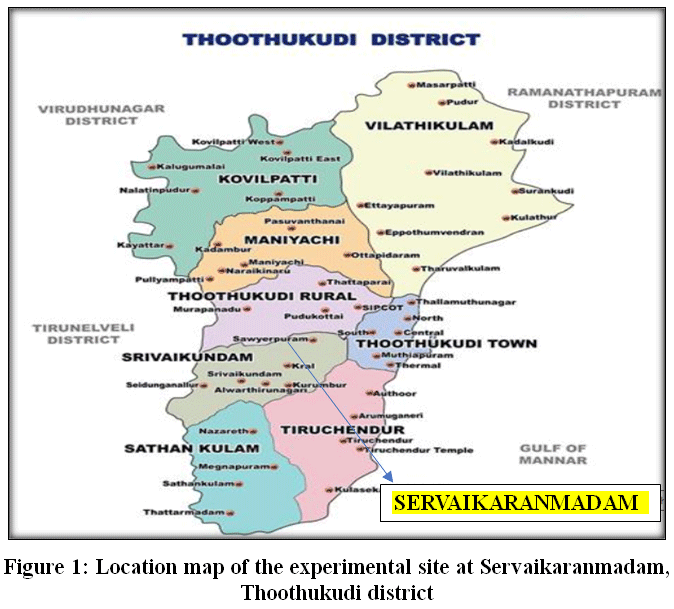 | Figure 1: Location map of the experimental site at Servaikaranmadam, Thoothukudi district.
|
Scanning Electron Microscope is a versatile instrument that is assiduous in inspecting the topographies of specimens.Due to the inefficiency of the wavelength of optical microscopes, the microscopic field has turned towards electron microscopes. While light microscopes can provide specimen resolution, scanning electron microscopes (SEM) can execute a thorough visual image of a particle with a spatial resolution of 1 nanometre. The SEM apparatus operates on the principle that the source emits Primary Electrons (PE), which in turn transfer their energy to the electrons residing in the Secondary Electrons (SE). By collecting these electrons from every point of the specimen, SEM provides detailed topographical and compositional information with high resolution.9ForSEM examination, the air-dried soil samples were mounted on aluminium stubs and coated prior to imaging to obtain clear surface morphology.SEM analysis was used for qualitative assessment of soil morphology.Dynamic Light Scattering (DLS) is used to analyse the motion of particles suspended in a solvent using laser light. The scattered light is measured at a specific angle. The technique is based on the Stokes-Einstein relationship and is suitable for determining particle sizesin the range of 0.8 - 6500 nm. DLS has a wide dynamic measurement range with good repeatability and is effective for analysing nanoparticle size. The technique uses a laser source, detector, and autocorrelator to process the scattered light and determine intensity fluctuations over time.For Dynamic Light Scattering (DLS) analysis, soil suspensions were prepared by dispersing a known quality of soil in distilled water, followed by proper mixing to ensure uniform dispersion before measurement. The DLS measurements were conducted for selected three treatments, and the mean particle size values were recorded. The collected data were analysed using descriptive statistical methods, and the outcomesare expressed as mean values.
Results
Soil morphology and structural features were examined using Scanning Electron Microscopy (SEM).Microstructural observations of goat manure revealed a porous and rugged surface (Fig. 2A). Swine manure samples exhibited pores on a spherical rough surface (Fig. 2B). Vermicompost appeared compact and flocky, with porous and granular formations (Fig. 2C).
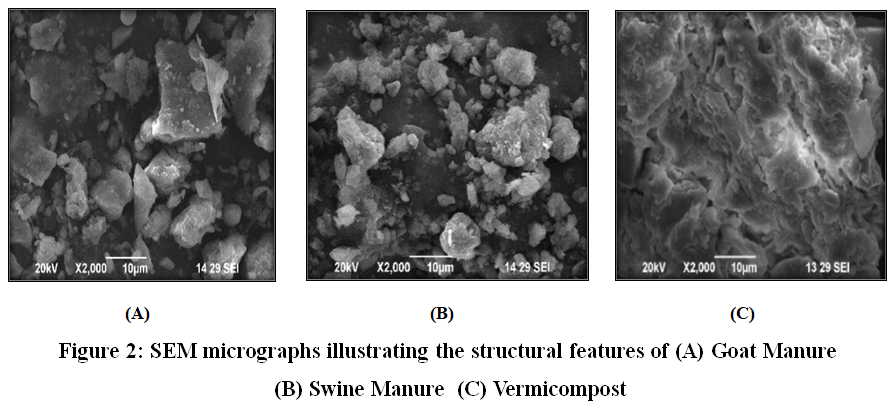 | Figure 2: SEM micrographs illustrating the structural features of (A) Goat Manure; (B) Swine Manure; (C) Vermicompost
|
Control samples displayed irregular, flaky, and sharp-edged particles (Fig. 3). Amended samples showed increased aggregation and enhanced porous structures. Microstructural observations of GM+VC (17 t ha-1)and GM+SM+VC (12.5 t ha-1) revealed a clustered appearance.The SM-treated plot @ 17 t ha-1 exhibited spherical and triangular particles as represented in Fig. 4(A - C).
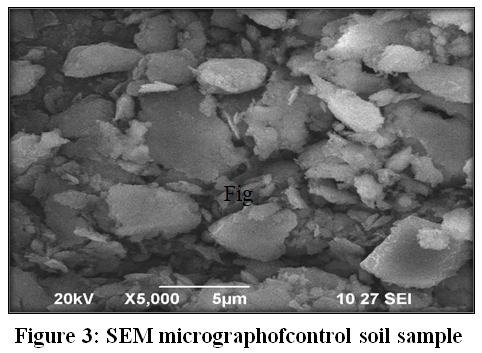 | Figure 3: SEM micrographofcontrol soil sample
|
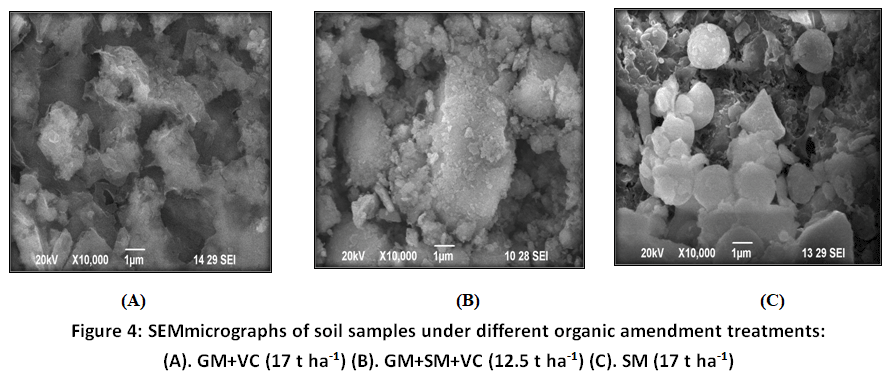 | Figure 4: SEMmicrographs of soil samples under different organic amendment treatments:
|
Particle size distributionwas analysed usingDynamic Light Scattering (DLS). The control plot showed a mean particle size of 892.9 nm (Fig. 5). Organic amendments increased particle size, with values of 1084.2 nm (GM+VC @ 17 t ha-1), 1092 nm (GM+SM+VC @ 12.5 t ha-1), and 893.4 nm (SM @ 17 t ha-1)as shown in Fig. 6(A - C) which are as follows:
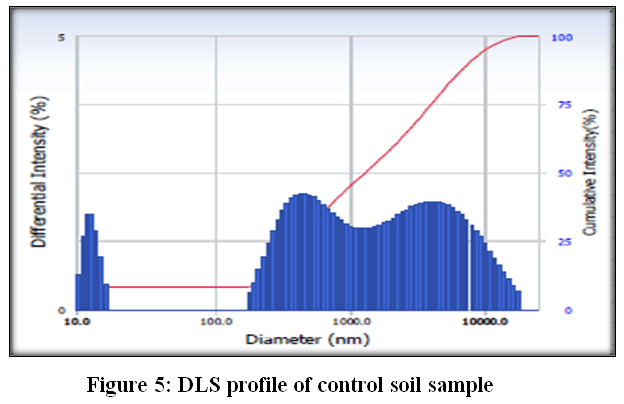 | Figure 5: DLS profile of control soil sample
|
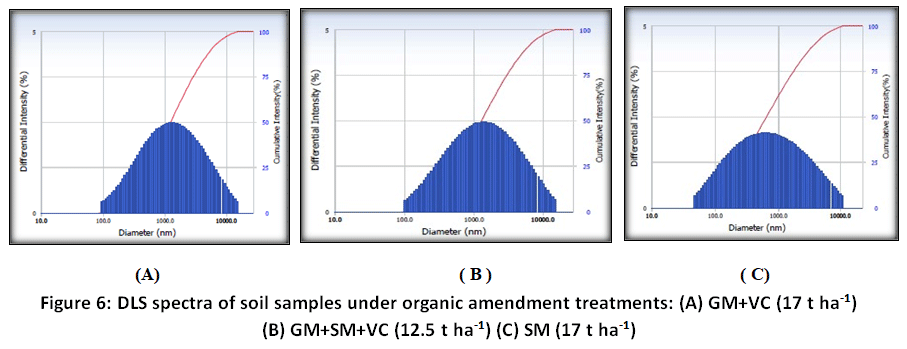 | Figure 6: DLS spectra of soil samples under organic amendment treatments: (A) GM+VC (17 t ha-1) (B) GM+SM+VC (12.5 t ha-1) (C) SM (17 t ha-1).
|
SEM images of goat manure showed a porous and rugged surface, it was with fine particles, enhancing water-holding capacity. Swine manure samples exhibited pores on a spherical rough surface it was consistent with sawdust-based compost.10,11Vermicompost appeared compacted and flocky, with porous and granular formations, attributed to microbial and earthworm activity. Organic manure-treated plots demonstrated increased aggregation, reducing spaces among soil particles, confirming improved soil structure. Control samples displayed irregular, flaky, and sharp-edged particles indicative of silicate minerals. SEM images of amended samples showed improvement in soil aeration and water retention. SEM images ofGM+VC (17 t ha-1) and GM+SM+VC (12.5 t ha-1) treatmentsconfirmed carbonaceous accumulation in it.12 The DLS measurements revealed that the application of organic amendments significantly influenced soil particle aggregation. Compared to the control, treatments involving goat manure (GM) and vermicompost (VC), as well as the integrated application of GM, swine manure (SM), and VC, led to increased mean particle sizes. This suggests enhanced soil aggregation due to organic matter-induced flocculation. Notably, the SM-alone treatment showed only a marginal increase (893.4 nm), indicating a lesser impact on aggregation compared to the combined amendments. These findings highlight the role of organic manure combinations in improving soil structural properties by promoting the formation of larger, more stable aggregates. SEM images supported this observation, showing increased porosity and structural integrity in amended soils. A comparison between DLS and SEM analyses provides a comprehensive understanding of soil particle characteristics. DLS measurements revealed an increase in particle size after organic manure application, confirming the formation of soil aggregates. This was further supported by SEM images, which visually depicted clustered particles and enhanced porosity in treated soil samples. The DLS data quantified the size distribution of these aggregates, while SEM provided morphological validation by showcasing structural modifications at a micro-level. These observations suggeststhat organic amendments promote better soil aggregation and aeration, thus improving nutrient retention and plant growth.13
Conclusion
This study demonstrates that a combined use of SEM, DLS, and image processing provides a comprehensive understanding of soil structural properties. Organic amendments significantly improved soil structure by enhancing particle aggregation and porosity, leading to better aeration, water retention, and nutrient availability. Such enhancements are essential for improving soil fertility and sustaining crop yield. The findings confirm that organic manure application promotes the formation of larger and more stable soil aggregates, thereby improving overall soil quality. Changes in particle size distribution and structural characteristics further support the positive impact of organic amendments on soil physicochemical properties. These results have important implications for sustainable agriculture, especially in the context of precision farming. The improved understanding of soil structural changes can be utilized in fertigation practises to optimize nutrient and water application based on soil conditions. Future research may focus on long term soil health, microbial activity, and the development of data driven, site-specific management strategies to enhance agricultural sustainability.
Acknowledgement
The authors gratefully acknowledge Karunya University, Coimbatore, for extending the analytical facilities and technical support.
Funding Sources
The authors received no financial support for the research, authorship, and/or publication of this article.
Conflict of Interest
The authors do not have any conflict of interest.
Data Availability Statement
The data generated during the SEM and DLS analyses of this study are available from the corresponding author on reasonable request.
Ethics Statement
This research did not involve human participants, animal subjects, or any material that requires ethical approval
Informed Consent Statement
This study did not involve human participants, and therefore, informed consent was not required.
Permission to reproduce material from other sources
Not Applicable.
Author Contributions
Suya Padhra Haridha: Conceptualization, methodology, experimentation, data analysis, interpretation of results, writing—original draft preparation, manuscript review and editing.
Pushpa Simson: Data collection, resources, validation and supervision
References
- Paulson T, Kumar D, Datta D, Saha R, Chakraborty D. Organic farming improves soil aggregation and organic carbon status in the rice–wheat cropping system in an Inceptisol. J. Indian Soc. Soil Sci. 2023:70(4), 456–463.
CrossRef - Singh S, Devi N. B, D, Kumar, A, Singh, S, Tyagi, G, Nath, A, Kumar, A. Soil fertility management: Role of organic amendments and bio-fertilizers. Int. J. Res. Agron. 2024:7(12), 766–772.
CrossRef - Al-Bared MAM, Marto A. A review on the geotechnical and engineering characteristics of marine clay and the modern methods of improvements. Malays. J. Fundam. Appl. Sci. 2017: 13(4): 825-831.
CrossRef - Rehman S U, De Castro F, Aprile A, Benedetti M, Fanizzi F P. Vermicompost: Enhancing plant growth and combating abiotic and biotic stress. Agronomy. 2023: 13(4), 1134.
CrossRef - Ani KA, Ochin E. Response Surface optimization and effects of agricultural wastes on total petroleum hydrocarbon degradation. Beni-Suef Univ. J. Basic Appl. Sci. 2018: 7: 564-574.
CrossRef - Das S, Mondal D, Bardhan S, Roy S, Maity A, Dutta S, Mukherjee K, Chanda DK, Das K. Particle size Mediated Investigation of Various Physicochemical Properties of Kaolinite Clay for Fabricating the Separator Layer of Green Capacitors. J. Mater. Sci.: Mater. Electron. 2022: 33(5), 7119–7133.
CrossRef - Akhtar N, Syakir M.I, Tweib S. A., Aminuddin M. I. K. A., Yusuff, M. S. M., Alsabhan A. H, lfaisal F. M, Alam S, Qadri, J. Particle Size Distribution and Composition of Soil Sample Analysis in a Single Pumping Well Using a Scanning Electron Microscope Coupled with an Energy Dispersive X-ray (SEM-EDX) and the Laser Diffraction Method (LDM). Water. 2023: 15(17), 3109.
CrossRef - Stetefeld J, McKenna S.A, Patel T.R. Dynamic light scattering: A practical guide and applications in biomedical sciences. Biophysical Reviews. 2016: 8(4), 409-427.
CrossRef - Sonwani S, Kulshreshtha U. Morphology, elemental composition, and source identification of air borne particles in Delhi, India. J. Indian Geophys. Union. 2018: 22, 607-620.
- Bajpai SK, Bajpai M, Rai N. Sorptive removal of ciprofloxacin hydrochloride from simulated wastewater using saw dust: Kinetic study and effect of pH.Water SA. 2012: 38(5), 673-682.
CrossRef - Ge J, Huang G, Huang J, Zeng J, Han L. Mechanisms and kinetics of organic matter degradation based on particle structure variation during pig manure aerobic composting. J. Hazard. Mater. 2015: 292, 19-26.
CrossRef - Zhang Y, Wang R, Li Z, Liu X. Characterization of soil microstructure and aggregation under organic amendments using scanning electron microscopy. Soil Tillage Res. 2022:220, 105365.
CrossRef - Verma S, Pradhan S S, Singh A, Kushwaha M. Effect of organic manure on different soil properties: A review. Int. J. Plant Soil Sci. 2024:36(5), 182–187.
CrossRef