Comparative Assessment of Solid Waste Management in Mysuru and Trichy: A Stakeholder and SWOT-Based Approach-Case Study
Kavya Prakash Siddeshwar
*

1
Department of Environmental Science and Management,
Bharathidasan University,
Tiruchirappalli,
Tamil Nadu
India
http://dx.doi.org/10.12944/CWE.20.2.30
Copy the following to cite this article:
Siddeshwar K. P. Comparative Assessment of Solid Waste Management in Mysuru and Trichy: A Stakeholder and SWOT-Based Approach-Case Study. Curr World Environ 2025;20(2). DOI:http://dx.doi.org/10.12944/CWE.20.2.30
Copy the following to cite this URL:
Siddeshwar K. P. Comparative Assessment of Solid Waste Management in Mysuru and Trichy: A Stakeholder and SWOT-Based Approach-Case Study. Curr World Environ 2025;20(2).
Download article (pdf)
Citation Manager
Publish History

Introduction
A sustainable approach to urban waste management requires a robust policy framework that effectively integrates the environmental, social, and economic factors. This holistic strategy should encompass all stages of waste reduction, recycling, resource recovery, and final disposal guided by the principles of waste hierarchy, circular economy, and life cycle assessment.1 Critical strategies such as the 3R principle (Reduce, Reuse, Recycle),2 state-of-the-art waste-to-energy technologies, smart systems, and cutting-edge recycling techniques are vital for the sustainability of municipal solid waste management (MSWM). Recognizing and incorporating the informal waste sector is a key element of this strategy, as it significantly contributes to the collection and recycling efforts of numerous developing nations. By supporting and formalizing this sector, it can be transformed into a financially viable solution that generates employment.3 Additionally, the involvement and active participation of the community are crucial for the success of any waste management plan. Collaborative governance models that include partnerships between local authorities and communities, have been shown to effectively improve implementation results.4
Implementing policies effectively necessitates engaging in data-driven decision-making, which is strengthened by continuous systems for monitoring and evaluation.5 Tools such as Life Cycle Assessment (LCA), Material Flow Analysis (MFA), and Multi-Criteria Decision Analysis (MCDA) are vital for crafting waste management policies that are both evidence-based and sensitive to the specific context.6 Urbanization and population growth intensify the strain on current MSWM systems, especially in developing nations such as India. The swift pace of industrialization and evolving consumption habits have resulted in a substantial rise in waste generation, surpassing the capabilities of numerous urban systems.7 At present, only 21% of municipal waste in India undergoes scientific treatment, with the remainder being dumped in open landfills. This situation underscores the urgent need for reforms that emphasize source segregation, composting, and development of advanced processing infrastructure.8
Global comparisons indicate that although nations such as China have adopted specific waste management strategies, they still face issues related to technical assistance and market incentives, highlighting shortcomings in governance.9 Integrated Solid Waste Management (ISWM) frameworks present viable solutions to these issues by focusing on essential elements such as waste characterization, financial planning, technology-driven data, and performance benchmarking.10,11 Technological advancements, including IoT-based smart systems and lifecycle tools, further improve operational efficiency and environmental outcomes.12,13 Urban governance plays a crucial role in determining the effectiveness of waste management strategies in India, as the success of these systems depends on institutional capacity, policy frameworks, and the inclusion of local stakeholders. Studies highlight that cooperative environmental governance, involving collaboration between government bodies, communities, and the informal sector, leads to more efficient waste management and better realization of waste-to-energy potential, but such cooperation is often lacking or poorly implemented in Indian cities.14-16
Notable examples such as Indore and Pune highlight the effectiveness of integrated and inclusive models. Indore has become a benchmark city under Swachh Bharat Abhiyan because of its initiatives such as door-to-door waste collection, mechanized street cleaning, human resource reforms, and public awareness campaigns.17,18 Pune, by involving informal workers through self-help groups, achieved a 95% waste segregation rate, demonstrating the benefits of community-led strategies.19 These cases emphasize the importance of integrating contributions from the informal sector, utilizing public-private partnerships, and embracing technological advancements in municipal solid waste management (MSWM).20,21 Stakeholder analysis has emerged as an essential method for identifying, comprehending, and managing the impact of different participants in waste governance. Collaborative governance frameworks that include governments, NGOs, private companies, and communities are becoming increasingly vital in addressing intricate waste issues. For instance, in Australia, adaptive multi-actor governance has been suggested to tackle structural inefficiencies,22 whereas in Ghana, stakeholder collaboration has effectively reduced waste buildup through shared motivation and coordinated efforts.23 In Bandung, a three-tiered collaborative model defines specific roles for waste management at the source, regional, and city levels.24 The importance of local communities is particularly pronounced. Although they are of considerable interest, their limited influence often leads to disputes, especially with the introduction of new waste facilities. This highlights the necessity for conflict-resolution strategies and inclusive stakeholder participation.25,26 Nonetheless, obstacles such as fragmented networks, ineffective communication, and lack of mutual understanding frequently hinder cooperation.27-29
In this scenario, Mysuru and Tiruchirappalli (Trichy) serve as contrasting yet insightful examples. Mysuru, a heritage city in Karnataka, has successfully adopted decentralized waste management and public-private partnership models. However, it still encounters difficulties owing to rapid urban expansion and the need for coordination across sectors.30,31 On the other hand, Trichy is struggling with rising waste volumes and environmental deterioration. Research points to significant problems such as heavy metal contamination and groundwater pollution, highlighting the critical need for sustainable waste management infrastructure.32,33
To achieve sustainable urban waste management, it is crucial to implement comprehensive, locally tailored, and inclusive strategies. This study primarily aims to conduct a comparative assessment of municipal solid waste management (MSWM) systems in Mysuru and Tiruchirappalli (Trichy) using a mixed-methods approach that combines both qualitative and quantitative data. Utilizing the SWOT analytical framework, this study seeks to evaluate the internal strengths and weaknesses as well as the external opportunities and threats affecting each city's waste management performance. It also examines key performance indicators such as door-to-door collection coverage, source segregation levels, waste processing rates, and reliance on infrastructure, particularly landfills. Additionally, the study performs detailed stakeholder mapping and influence-impact analysis, identifying the roles and perceptions of five major groups: municipal corporations, sanitation workers, residents, NGOs, and planning departments. Through this dual-layered analysis, this study aimed to generate context-specific insights and inform evidence-based strategies for improving urban waste governance, infrastructure planning, and stakeholder engagement in Indian cities.
Materials and Methods
This study utilized a mixed-methods strategy to examine solid waste management practices in Mysuru and Trichy, combining qualitative and quantitative techniques to assess system effectiveness and stakeholder interactions. The main analytical framework employed was Strategic Strengths, Weaknesses, Opportunities, and Threats (SWOT) analysis, which was used to systematically evaluate waste management systems. This framework facilitated a structured assessment of both internal capabilities and external influences impacting municipal solid waste management, offering a standardized method for comparing different cities.
Data were gathered from a various source, including municipal records, government documents, field observations, and consultations with stakeholders. Key performance indicators were recorded, including the extent of door-to-door collection, rates of source segregation, percentages of waste processing, infrastructure capacity, and reliance on landfills. Field observations directly confirmed the reported metrics, whereas interviews with stakeholders provided a range of perspectives on the challenges faced by the system. A thorough stakeholder mapping exercise identified five main groups: Municipal Corporations (MCC/TCMC), sanitation workers, residents, NGOs, and City Planning departments. Each of these stakeholders was evaluated based on four aspects: primary interests, strategies of influence, possible impacts, and operational conflicts. Stakeholders were assessed quantitatively through a two-dimensional framework that evaluated their influence (decision-making authority) and impact (effect on waste management results) on a scale of 1 to 5, facilitating a systematic assessment and providing actionable insights for policy formulation.
Results
Table 1: A SWOT Analysis of Waste Management Practices in Mysuru
Strengths | Weakness |
Comprehensive Waste Management Effective Segregation and Processing Robust Infrastructure Strategic Partnerships Extensive Reach and Coverage | Underutilized Decentralized System Stuboptimal Segregation Practices Continued Reliance on Landfilling Inadequate Resource Allocation Inefficient Collection Practices The lack of a dedicated leachate treatment facility constrains Mysuru's capacity to manage liquid waste effectively. |
Opportunities | Threats |
Optimize Decentralized Processing Enhance Citizen Engagement Diversify Waste Processing Strengthen Collection Efficiency Maximize Resource Recovery | Environmental and Health Risks Resource Constraints Waste Accumulation and Overflow Limited Recycling and Resource Recovery Policy and Enforcement Gaps |
Strengths
Mysuru’s Solid Waste Management (SWM) system has earned a reputation as one of India’s most efficient services and a model for other municipalities seeking sustainable waste management solutions. The city achieves 97% door-to-door waste collection coverage, which minimizes littering and enhances the waste collection efficiency. Mysuru has a solid source segregation rate of 70%, indicating the effectiveness of public awareness campaigns and household compliance. The city processes 94% of its waste, significantly reducing dependence on landfills. Two new landfills were established in 2023 to address the increasing waste management demands and reduce the burden on the pre-existing facility, supplementing Mysuru's centralized waste processing infrastructure, which includes Kesare (200 TPD) and Rayankere (150 TPD) plants. The city’s 100% remediation of dumpsites and its commitment to cleanliness in public spaces further enhance its sustainability efforts. The city also boasts a well-established circular economy with initiatives such as the Nandi Compost production from wet waste, helping to reduce pressure on landfills.
Weaknesses
However, Mysuru faces several challenges. The Vidyaranyapuram landfill continues to handle significant legacy waste, approximately 6.5 lakh tonnes of waste, accumulated over the last 20 years. The leachate treatment system in Mysuru, located at Vidyaranyapuram, utilizes an engineered landfill equipped with a high-density polyethylene (HDPE) liner. This system directs leachate to an on-site sewage treatment plant (STP) for processing, after which the treated water is repurposed for gardening and irrigation. However, the continued reliance on rudimentary methods is inadequate in managing the increasing volumes of waste, posing risks of overflow during monsoon seasons, and failing to effectively prevent groundwater contamination. This unresolved issue hampers progress and contributes to ongoing waste management struggles in cities. Additionally, 30% of the households failed to comply with waste segregation, placing more pressure on sanitation workers. Although 94% of the waste is processed, the remaining 6% is either landfilled or improperly dumped, thereby posing environmental risks. The underutilization of zero waste management (ZWM) facilities is another limitation, that could help alleviate the load on centralized systems. Furthermore, the average number of sanitation workers per ward is not sufficient to handle the growing waste volumes, particularly during festivals when waste generation peaks.
Opportunities
Activating underutilized ZWM facilities can reduce centralized processing reliance and improve waste management efficiency. Enhanced public awareness campaigns could increase segregation compliance, while expanding anaerobic composting and promoting Nandi Compost could reduce wet waste sent to landfills. Implementing GPS tracking and real-time monitoring can improve operational transparency and waste collection efficiency.
Threats
Mysuru’s over-reliance on centralized facilities creates vulnerabilities, with technical failures leading to operational disruptions. Political interference has delayed biomining in Vidyaranyapuram, exacerbating the problem of legacy waste. Additionally, the growing population and waste generation pose the risk of overwhelming the existing infrastructure, particularly during peak periods. Without comprehensive solutions, Mysuru risks a decline in its SWM performance and national ranking.
Table 2: A SWOT Analysis of Waste Management Practices in Trichy
Strengths | Weakness |
Existing Infrastructure High Biodegradable Waste Inert Waste Diversion Biomining Initiative C&D Waste Recycling Plan | Significant Waste Generation Reliance on single landfilling Limited Non-Biodegradable Processing Unclear Resource Recovery Efficiency Implementation Challenges |
Opportunities | Threats |
Optimize Micro-Composting Maximize Biodegradable Waste Utilization Enhance Non-Biodegradable Waste Management Resource Recovery Enhancement Promote Public Awareness | Increasing Waste Generation Landfill Capacity Constraints Funding and Resource Availability The unmanaged leachate originating from the Ariyamangalam dump yard constitutes a significant threat to the quality of both groundwater and surface water in Trichy. Public Awareness and Participation Implementation Delays |
Strengths
Trichy’s SWM system has several advantages. The city has achieved 100% door-to-door waste collection, ensured comprehensive coverage, and minimized litter across both residential and commercial areas. The 89% source segregation rate reflects robust public participation and awareness. Trichy processes 76% of its waste and remediates 100% of its dumpsites, transforming potential environmental hazards into usable spaces. Additionally, the city maintains 100% cleanliness across residential neighborhoods, market areas, and water bodies, enhancing urban aesthetics and public health. Its sanitation infrastructure, with a 95% cleanliness rating for public toilets, further solidified its strong Swachh Survekshan rankings. Infrastructure-wise, Trichy boasts 36 micro composting plants (five TPD capacities each) and four Material Recovery Facilities (MRFs), which facilitate decentralized waste processing and improve efficiency. The city’s practice of sending inert waste to cement factories instead of landfilling highlights its innovative and sustainable approach. Biomining initiatives, including the planned phase three at Ariyamangalam, underline their commitment to effectively address legacy waste.
Weaknesses
Despite these achievements, Trichy has faced challenges. Processing 76% of its waste leaves 24% unmanaged, risking landfill overflow and open dumping, which poses environmental and public health risks. The remaining 11% of the households that did not comply with segregation practices strained the system, necessitating additional sorting efforts. The reliance on centralized waste processing facilities increases transportation costs and limits flexibility, whereas the lack of sufficient decentralized infrastructure could become a bottleneck as waste generation increases.
Opportunities
Trichy offers substantial opportunities for enhancing SWM practices. Establishing additional decentralized processing facilities would reduce reliance on centralized system and improve operational efficiency. Expanding the use of waste-to-energy technologies can help to manage unprocessed waste while generating economic returns. Ongoing biomining efforts at Ariyamangalam have provided an opportunity to remediate legacy waste. Partnerships with private entities and technology firms can facilitate the modernization of the system.
Threats
Trichy’s growing population and increasing waste generation rates threaten to overwhelm its infrastructure. Dependence on centralized facilities renders a city vulnerable to operational disruptions. Trichy lacks a formal leachate treatment system at the Ariyamangalam dump yard, leading to uncontrolled discharge of leachate into the surrounding soil and water bodies, particularly during the monsoon. This situation poses a significant risk of groundwater contamination as well as long-term public health and environmental hazards, underscoring the need for scientific intervention. Limited funding and reliance on private partnerships pose financial risks. Non-compliance with segregation practices and festive waste surges remains a recurring challenge, requiring robust contingency planning to mitigate their impacts.
Both cities face significant hurdles such as financial limitations, insufficient funding, and seasonal waste spikes during festivals. These challenges underscore the necessity of backup strategies and infrastructure improvements to ensure the long-term viability of waste management systems.
Table 3: Mysuru Stakeholder Analysis
Stakeholder | Key Interests (Mysuru) | Major Influence Strategies (Mysuru) | Possible Consequences (Mysuru) | Potential Conflicts (Mysuru) |
Municipal Corporations (MCC) | Effective waste management, adherence to regulations, fiscal efficiency | Execution of policy, distribution of resources, enforcement | Comprehensive system efficacy, service provision | Balancing budgetary limitations, societal opposition, and operational deficiencies |
Sanitation Workers (Mysuru) | Safe working conditions, social recognition | Frontline service delivery, potential for work slowdowns | Collection efficiency, public health | Low wages, social stigma, lack of equipment |
Residents (Mysuru) | Clean neighbourhoods, convenient waste disposal, public health | Participation, feedback, complaints, non-compliance | Waste segregation, volume, public cooperation | NIMBYism, non-compliance, lack of awareness |
NGOs (Mysuru) | Sustainable waste management, community engagement, environmental protection | Advocacy, awareness campaigns, community projects | Public opinion, behaviour, community participation | Funding constraints, limited influence, navigating political landscapes |
City Planning Departments (Mysuru) | Sustainable urban development, effective land use planning, minimization of waste impact | Land use regulation, zoning, long-term infrastructure planning | Long-term waste generation, infrastructure placement, environmental impact | Balancing development pressures, environmental concerns, lack of coordination. |
The Municipal Corporation of Mysuru (MCC) serves as the main body responsible for managing waste operations and concentrating on effective collection, adherence to regulations, and financial viability. The MCC formulates policies, distributes resources, and enforces rules that have a direct impact on the system's efficiency and the quality of services provided. Although their decisions improve waste collection and public health, challenges such as budget limitations, public opposition, and operational inefficiencies hinder optimal performance.
Sanitation workers form the essential foundation of waste management operations, focusing on receiving fair pay, ensuring safe working environments, and gaining social acknowledgment. Their work has a direct impact on the efficiency of waste collection and the health of the public. Nevertheless, challenges such as low wages, lack of adequate protective gear, and societal stigma lead to service disruptions and decreased operational efficiency. Residents play a dual role as producers of waste and crucial stakeholders whose collaboration is essential for the system's success. Their main priorities include maintaining neighborhood cleanliness, ensuring easy access to disposal options, and safeguarding public health. The effectiveness of waste management is largely dependent on residents' involvement in the sorting and disposal of waste. Challenges such as non-compliance, lack of awareness, and NIMBY (Not In My Back Yard) attitudes pose significant operational difficulties, resulting in waste buildup and environmental harm.
Non-Governmental Organizations prioritize sustainable practices, community involvement, and environmental conservation through advocacy, awareness efforts, and local projects. Although they shape public behavior and improve management practices, their ability to make a large-scale impact is limited by funding challenges, restricted policy influence, and complex political landscapes. The City Planning Department incorporates waste management into urban development plans by concentrating on optimizing land use, enforcing zoning regulations, and reducing the impact on infrastructure. They anticipate future waste generation and determine where to place infrastructure, yet they encounter difficulties in balancing urban expansion with environmental conservation and coordination between departments, which affects the effectiveness of strategic implementation.
Table 4: Trichy Stakeholder Analysis
Stakeholder | Key Interests (Trichy) | Primary Influence Tactics (Trichy) | Potential Impacts (Trichy) | Potential Conflicts (Trichy) |
Municipal Corporations (TCMC) | Efficient waste management, regulatory compliance, community engagement | Policy implementation, resource allocation, public campaigns | Overall system effectiveness, service delivery, community participation | Balancing service delivery, maintaining community engagement, infrastructure development |
Sanitation Workers (Trichy) | Fair wages, safe working conditions, social recognition, community acceptance | Frontline service delivery, potential for work slowdowns, community interaction | Collection efficiency, public health, community relations | Potential for low wages, need for equipment, improved community relations |
Residents (Trichy) | Clean neighbourhoods, convenient waste disposal, public health, effective source segregation | Participation, feedback, active community engagement | Waste segregation, volume, community cooperation, successful source segregation | Maintaining high segregation rates, addressing specific community needs |
NGOs (Trichy) | Sustainable waste management, community empowerment, environmental awareness | Advocacy, community-based projects, awareness campaigns | Community participation, environmental awareness, successful projects | Funding constraints, maintaining community momentum, long term project viability. |
City Planning Departments (Trichy) | Sustainable urban development, integrated waste management planning, long term infrastructure planning | Land use regulation, zoning, infrastructure planning, community interaction | Long-term waste management strategy, integrated urban planning, community centered development | Balancing development pressures, integrating waste management into urban planning, maintaining community trust. |
The Tiruchirappalli City Municipal Corporation (TCMC) oversees waste management, ensures adherence to regulations, and engages with the community by implementing policies, allocating resources, and conducting public awareness initiatives. The efficiency significantly influences the delivery of services and community involvement, although it faces the challenge of balancing service delivery with infrastructure development and maintaining ongoing community engagement. In Trichy, sanitation workers emphasize the importance of receiving fair pay, having safe working environments, and gaining acceptance from the community. Their active participation in waste collection and interactions with the public plays a crucial role in enhancing operational efficiency and fostering positive community relations. However, low wages, lack of adequate protective gear, and unfavorable working conditions impede their productivity and overall effectiveness of the system.
Residents are actively involved in waste management, emphasizing neighborhood tidiness and easy access to disposal options. Their collaboration is crucial for the success of the source separation and recycling programs. Nonetheless, achieving high levels of segregation across various communities and maintaining consistent participation remains a persistent challenge. Non-governmental organizations advance sustainable waste management by engaging in advocacy, conducting awareness initiatives, and implementing community projects. These efforts aimed to boost public participation and encourage responsible waste disposal. However, the impact and the longevity of their projects are often hindered by financial constraints and challenges in sustaining community involvement over time.
The City Planning Department integrates waste management into urban development by utilizing land use regulations, zoning policies, and infrastructure planning. Although coordinated systems can improve urban sustainability, achieving a balance between growth demands and waste management needs, while maintaining community trust necessitates effective collaboration among various agencies.
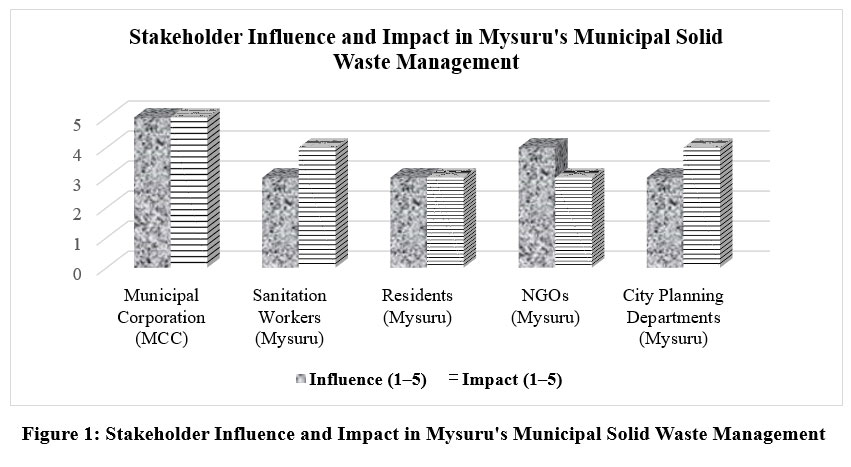 | Figure 1: Stakeholder Influence and Impact in Mysuru's Municipal Solid Waste Management
|
The figure 1, illustrates the influence and impact of different stakeholders in Mysuru’s municipal solid waste management (MSWM). The stakeholders considered included Municipal Corporations (MCC), Sanitation Workers, Residents, NGOs, and City Planning Departments.
The Municipal Corporation of Mysuru (MCC) has the highest influence and impact (both rated 5), highlighting its pivotal role in policymaking, regulation, and the execution of waste management strategies. Sanitation workers exhibit a high impact but lower influence, indicating their direct involvement in waste collection and disposal but limited decision-making authority. City Planning Departments show moderate influence and impact, as they contribute to infrastructure development but do not directly engage in daily waste management activities. NGOs and residents display the least influence and impact, signifying their relatively smaller role in decision-making and execution, despite their potential contributions to awareness and community-based initiatives.
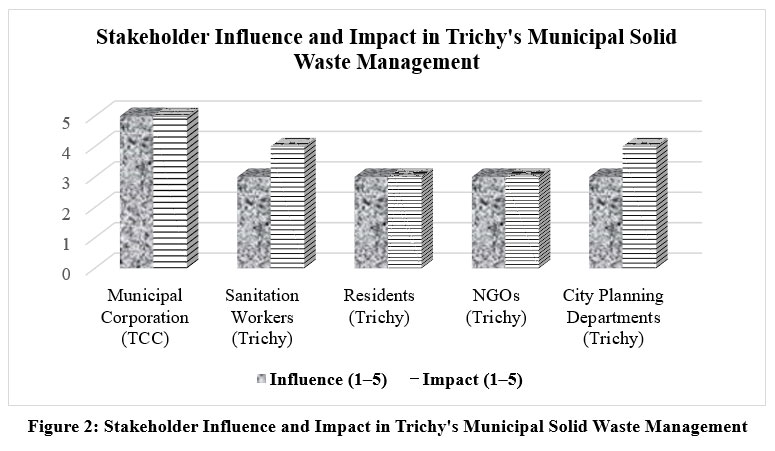 | Figure 2: Stakeholder Influence and Impact in Trichy's Municipal Solid Waste Management
|
The figure 2, presents a similar analysis for Trichy’s Municipal Solid Waste Management (MSWM). The stakeholders evaluated were Municipal Corporations (TCMC), Sanitation Workers, Residents, NGOs, and City Planning Departments. Influence and impact were rated on a scale of 1_5. Like Mysuru, Trichy’s Municipal Corporation (TCMC) has the highest influence and impact, playing a central role in managing waste policies and regulations. Sanitation workers again show a higher impact but lower influence, reaffirming their direct role in waste handling but lack of decision-making power. City Planning Departments have moderate influence and impact, reflecting their involvement in infrastructure and land-use planning for waste management. Interestingly, NGOs and residents in Trichy have very low influence and impact, which suggests less community engagement in waste management practices compared to Mysuru.
When comparing the two cities, a common pattern emerges where municipal corporations exert the highest influence and impact, followed by sanitation workers, and city planning departments. However, differences can be observed between the roles of NGOs and residents. In Mysuru, these groups have slightly more influence and impact than Trichy, indicating a relatively more active community and civil society engagement in waste management. Additionally, the gap between influence and impact varied across stakeholders in both cities. Sanitation workers have a high impact but a low influence, suggesting the need for more empowerment and representation in decision-making. Meanwhile, city planning departments have balanced but moderate ratings, emphasizing their supportive roles in infrastructure and policy frameworks.
Discussion
The comparison between Mysuru and Tiruchirappalli (Trichy) highlights the significant differences in their approaches to managing solid waste in medium-sized Indian cities. Mysuru has implemented a decentralized system that benefits from public-private partnerships and community involvement, resulting in a high rate of source segregation at 70% and enhanced composting methods. In contrast, Trichy achieved full waste collection and an impressive 89% segregation rate, primarily through decentralized collection networks. Nevertheless, it falls short of downstream processing and lacks comprehensive integration throughout its solid waste management chain.
Stakeholder analysis is a common issue in governance. Municipal corporations have the most power, but important groups such as sanitation workers and residents are excluded from planning and action. In Mysuru, support for NGOs and community groups has helped raise awareness and improve waste management practices. In Trichy, stakeholders are less involved, which weakens local accountability and flexibility. The SWOT analysis shows Mysuru is strong in infrastructure and consistent policies, while Trichy is strong in grassroots innovations. Both cities face issues such as processing delays, legacy waste buildup, and environmental risks.
The inadequate scientific treatment of leachate is a significant issue in both systems. Mysuru's dependence on evaporation ponds and the limited application of electrocoagulation at the Vidyaranyapuram site proved insufficient during peak monsoon periods. The Ariyamangalam dump yard in Trichy lacks basic containment systems, resulting in leachate contamination of the nearby groundwater. A MODFLOW–MT3DMS modelling study further confirms the radial dispersion of a TDS plume over nearly a decade, underscoring the continuous mobilization of leachate contaminants into adjacent aquifers.34 To reduce these environmental risks, we need to invest in special systems to contain waste and use new methods to treat leachate. An effective and low-cost method is a hybrid phytoremediation model. It uses plants such as Jatropha curcas, vetiver grass, duckweed, and Chlorella vulgaris to remove over 60% of pollutants from leachate. This method also helps recover biomass and can be used to produce biofuel.35 Furthermore, the incorporation of membrane bioreactors, sequential batch reactors, and regular groundwater monitoring is crucial to ensure the long-term efficacy and environmental compliance of leachate management.36-38
In the Swachh Survekshan 2023, Mysuru and Tiruchirappalli were ranked in the mid-tier of national cleanliness with Trichy leading city in Tamil Nadu, but both needed to improve waste processing and sorting. Recent checks for 2024-25 show big improvements. Mysuru has become a leading performer nationwide, while Trichy is gaining recognition as a rising leader in its population category. Sustained consistency is paramount for building upon these achievements, necessitating targeted investment in enhanced waste processing infrastructure and the implementation of comprehensive public awareness programs for holistic waste management.39 Key suggestions include: (1) reactivating underused decentralized processing units, (2) launching extensive public awareness initiatives to enhance compliance with segregation, (3) creating mechanisms for stakeholder coordination to tackle power disparities, (4) speeding up the biomining of legacy waste through non-political execution, and (5) creating innovative and nature-aligned solutions for leachate processing to strengthen ecological resilience and fulfil circular economy objectives. In the absence of such interventions, both cities remain environmentally vulnerable, which consequently undermines the otherwise promising advancements in waste collection and segregation.
Conclusion
This comparative study highlights that both Mysuru and Trichy have established effective solid waste management systems, each with unique operational strategies. Mysuru's centralized approach excels in terms of processing efficiency, whereas Trichy's decentralized system offers operational robustness. Nonetheless, both cities encounter similar challenges, such as the accumulation of legacy waste, gaps in segregation compliance, and issues with stakeholder coordination. Stakeholder analysis reveals notable power disparities, with municipal corporations exerting significant control over decision-making processes, while frontline workers are underrepresented. This imbalance leads to operational inefficiencies and hinders system optimization. Additionally, community involvement is lacking in both cities, highlighting a crucial area that requires enhancement.
This study helps us to understand how Indian cities handle waste. This shows that successful waste management requires strong infrastructure, public involvement, and active community participation. These findings offer valuable ideas for policymakers and city planners to develop effective waste management plans in similar urban areas. They emphasized the importance of flexible management that adapts to local needs while being efficient and environmentally sustainable.
Acknowledgement
I wish to express my gratitude to the Mysuru City Corporation (MCC) and the Tiruchirappalli City Municipal Corporation (TCMC) for their invaluable insights and assistance in grasping local solid waste management practices. The publicly accessible information and guidance from the Swachh Bharat Mission were also instrumental in enhancing my understanding and analysis of waste management in Mysuru and Trichy, significantly contributing to the development of this study.
Funding Sources
The corresponding author (IF170901) gratefully acknowledges financial support from the DST-Inspire scheme, Government of India, which was essential for enabling this research.
Conflict of Interest
The author does not have any conflict of interest.
Data Availability Statement
Data examined throughout this study is provided within the manuscript.
Ethics Statement
This research did not involve human participants, animal subjects, or any materials that required ethical approval.
Informed Consent Statement
All stakeholders participating in the study gave their informed consent, which guaranteed both their voluntary involvement and the confidentiality of their responses. Data was gathered through interviews and field observations, with prior approval and in compliance with ethical research guidelines.
Permission to reproduce material from other sources
Not Applicable
Author Contributions
The sole author was responsible for the conceptualization, methodology, data collection, analysis, writing, and final approval of the manuscript.
References
- Rani TS, Madhurima Yendluri J. Sustainable waste management: innovations and best practices. Int J Innov Sci Res Technol. 2024:2686-2689. https://doi.org/10.38124/ijisrt/IJISRT24AUG1613
CrossRef - Zakhilwal SA, Shirzad W, Behsoodi MM. A comprehensive review of engineering strategies for environmental sustainability in sustainable waste management. Int J Curr Sci Res Rev. 2024;7(10):7456-7468. 10.47191/ijcsrr/V7-i10-02
- Kala K, Bolia NB. Empowering the informal sector in urban waste management: Towards a comprehensive waste management policy for India. Environmental Development. Published online February 1, 2024:100968-100968. https://doi.org/10.1016/j.envdev.2024.100968
CrossRef - Tuanaya W. Building Eco-Friendly Cities: Government-Community Collaboration In Shaping Sustainable Urban Waste Management. Baileo: Jurnal Sosial Humaniora. 2024;1(3):281-292. https://doi.org/10.30598/baileofisipvol1iss3pp281-292
CrossRef - Kanade TM, Joseph J, Ansari S, Varghese AM, Savale T. Solid Waste Management for Environmental Sustainability and Human Health. J Informatics Educ Res. 2024;4(1). doi:10.52783/jier.v4i1.599.
CrossRef - Ahmed Abdel-Rahim EI, Abdelhafeez A. Rethinking Waste Management: A Holistic Sustainability Framework for a Circular Economy. Journal of Sustainable Development and Green Technology. 2023;2(2):26-33. https://doi.org/10.54216/JSDGT.020203
CrossRef - Singh R, Majumder CB, Ajit Kumar Vidyarthi. Recent Developments in Municipal Solid Waste Management in India. Practice, progress, and proficiency in sustainability. Published online August 2, 2024:407-440. 10.4018/979-8-3693-4054-7.ch016
CrossRef - Prajapati KK, Yadav M, Singh RM, Parikh P, Pareek N, Vivekanand V. An overview of municipal solid waste management in Jaipur city, India - Current status, challenges and recommendations. Renewable and Sustainable Energy Reviews. 2021;152:111703. https://doi.org/10.1016/j.rser.2021.111703
CrossRef - Tan Z, Ren Y, Han J, Chen S. Evolving pattern and improvement path of China’s solid waste management policies. Chinese Journal of Population, Resources and Environment. 2021;19(4):358-368. https://doi.org/10.1016/j.cjpre.2022.01.009
CrossRef - Cheela VRS, Ranjan VP, Goel S, John M, Dubey B. Pathways to sustainable waste management in Indian Smart Cities. Journal of Urban Management. 2021;10(4). https://doi.org/10.1016/j.jum.2021.05.002
CrossRef - Szpilko D, Antonio, Félix Jiménez Naharro, Rzepka A, Remiszewska A. Waste Management in the Smart City: Current Practices and Future Directions. Resources. 2023;12(10):115-115. https://doi.org/10.3390/resources12100115
CrossRef - Saha S, Chaki R. IoT based smart waste management system in aspect of COVID-19. Journal of Open Innovation: Technology, Market, and Complexity. 2023;9(2):100048. https://doi.org/10.1016/j.joitmc.2023.100048
CrossRef - Rai S, Gurung A, Hari Bhakta Sharma, Ved Prakash Ranjan, Ravi V. Sustainable solid waste management challenges in hill cities of developing Countries: Insights from eastern Himalayan smart cities of Sikkim, India. Waste management bulletin (Amsterdam). Published online March 1, 2024. https://doi.org/10.1016/j.wmb.2024.02.009
CrossRef - Sakib Bin Amin, Mahatab Kabir Khandaker, Juhi Jannat, Khan F, Shah Zahidur Rahman. Cooperative environmental governance in urban South Asia: implications for municipal waste management and waste-to-energy. Environmental Science and Pollution Research. 2023;30(26):69550-69563. https://dx.doi.org/10.21608/aujes.2023.229272.1185
CrossRef - Priti, Mandal K. Review on evolution of municipal solid waste management in India: practices, challenges and policy implications. Journal of Material Cycles and Waste Management. 2019;21. https://doi.org/10.1007/s10163-019-00880-y
CrossRef - Pal MS, Bhatia M. Current status, topographical constraints, and implementation strategy of municipal solid waste in India: a review. Arabian Journal of Geosciences. 2022;15(12). https://doi.org/10.1007/s12517-022-10414-w
CrossRef - Mohini Jadon. A Study of Solid Waste Management in Indore City: With Special Reference to Biomedical Waste. Springer eBooks. Published online January 1, 2020:287-292. https://doi.org/10.1007/978-981-15-0532-4_28
CrossRef - Wagle S, Arora A. Deciphering the Indore Story: Assessing Municipal Solid Waste Management in the Last Mile of Operations. Lecture notes in civil engineering. Published online January 1, 2021:39-49. https://doi.org/10.1007/978-981-33-4114-2_4
CrossRef - Saifi N, Jha B. An Overview of Solid Waste Management Practices in Pune, Maharashtra, India. Nature Environment and Pollution Technology. 2024;23(2):923-934. https://doi.org/10.46488/NEPT.2024.v23i02.027
CrossRef - Ambastha R, Aich S. Decentralized Community-Led Solid Waste Management. Sustainable Waste Management: Policies and Case Studies. Published online June 22, 2019:77-89. https://doi.org/10.1007/978-981-13-7071-7_7
CrossRef - Kumar J. Municipal waste management in tier-2 cities in northern India. Int J Sci Res Eng Manag. 2024;8(6):1-5. http://dx.doi.org/10.55041/IJSREM35863
CrossRef - Jones S. Waste Management in Australia Is an Environmental Crisis: What Needs to Change so Adaptive Governance Can Help? Sustainability. 2020;12(21):9212. https://doi.org/10.3390/su12219212
CrossRef - Abdulai IA, Fuseini MN, File DJM-Buu. Making cities clean with collaborative governance of solid waste infrastructure in Ghana. Cleaner Waste Systems. 2024;8:100150. https://doi.org/10.1016/j.clwas.2024.100150
CrossRef - Jati Puspita Rini, Ely Sufianti, Abdullah S. Collaborative Governance Model Integrated Waste Management in Bandung City. Advances in social science, education and humanities research. Published online January 1, 2021. https://doi.org/10.2991/assehr.k.210629.043
CrossRef - Tennakoon M, Kulatunga U. Stakeholder Management Models for Solid Waste Management Projects. https://www.ieomsociety.org/singapore2021/papers/547.
CrossRef - Sei Slehkie CW, Dongjie N. Assessing Stakeholder’s Collaboration in the Management of Municipal Solid Waste in Monrovia, Liberia. International Journal of Scientific and Research Publications (IJSRP). 2021;11(4):81-93. http://dx.doi.org/10.29322/IJSRP.11.04.2021.p11210
CrossRef - Soni A, Das PK, Kumar P. A review on the municipal solid waste management status, challenges and potential for the future Indian cities. Environment, Development and Sustainability. 2022. https://doi.org/10.1007/s10668-022-02688-7
CrossRef - Hossain R, Islam MT, Shanker R, Khan D, Locock KES, Ghose A, Schandl H, Dhodapkar R, Sahajwalla V. Plastic Waste Management in India: Challenges, Opportunities, and Roadmap for Circular Economy. Sustainability. 2022;14(8):4425. doi:10.3390/su14084425
CrossRef - Jarotwan Koiwanit, Viachaslau Filimonau. Stakeholder collaboration for solid waste management in a small tourism island. PLOS ONE. 2023;18(7):e0288839-e0288839.
CrossRef - Hettiarachchi H, Mhaddolkar N. Mysuru. SDG 11, Sustainable Cities and Communities. Published online April 28, 2022:37-57.
CrossRef - Betsurmath CG. Plastic Waste Management: The Mysore Experiment. Published online January 1, 2025:361-372. https://doi.org/10.1007/978-981-96-2343-3_18
CrossRef - Arumugam K, Pandiyan B, Baskaran J, Mangottiri V. Evaluation of water quality index for assessing groundwater appraisal near solid waste dumpsite at Ariyamangalam, Trichy, Tamil Nadu. Materials Today: Proceedings. 2022;64:1081-1086. https://doi.org/10.1016/j.matpr.2022.05.366
CrossRef - R. Shanmuga Priya, T. Thyagaraj. Hydraulic Conductivity and Chemical Compatibility of Trichy Clay for Municipal Solid Waste Landfill Liner Applications. Published online February 27, 2025:418-430. https://doi.org/10.1061/9780784485699.045
CrossRef - Kanmani S, Gandhimathi R, Shanmuharajan MB, Ponraj.M, Srinivasan.N.P, Sharmiladevi. K, Vivek. S. Leachate transport phenomenon on groundwater quality: modeling using MODFLOW and MT3DMS tools. Global NEST J. 2023;25(3):44-55. https://doi.org/10.30955/gnj.004564
CrossRef - Roychoudhury A, Singh N, Veeraraghavan A. Hybrid phytoremediation: an ultimate bio-solution for leachate. Global NEST J. 2020;22(2):197-206. http://dx.doi.org/10.30955/gnj.003167
CrossRef - Farsani MH, Reza Jalilzadeh Yengejeh, Alireza Hajiseyed Mirzahosseini, Masoud Monavari, Hassani A hessam, Nezamaddin Mengelizadeh. Effective leachate treatment by a pilot-scale submerged electro-membrane bioreactor. Environmental Science and Pollution Research. 2021;29(6):9218-9231. https://doi.org/10.1007/s11356-021-16196-0
CrossRef - Anna Ta?a?aj I, Bartkowska I, Biedka P. Treatment of young and stabilized landfill leachate by integrated sequencing batch reactor (SBR) and reverse osmosis (RO) process. Environmental Nanotechnology, Monitoring & Management. Published online June 2021:100502. https://doi.org/10.1016/j.enmm.2021.100502
CrossRef - Soukaina Bouaouda, Salah Souabi, Roukaya Bouyakhsass, Taleb A, Abdelaziz Madinzi, Abdelkader Anouzla. Techniques for treating leachate discharges: A critical review. Euro-Mediterranean Journal for Environmental Integration. 2023;8(3):573-599. https://doi.org/10.1007/s41207-023-00366-2
CrossRef - Swachh Survekshan – 2023, Report cards for Mysuru and Trichy - https://ss2023.sbmurban.org/