
Comparative Study of Sal (Shorea robusta Gaertn. f.) Regeneration in Assisted and Non-assisted Natural Regeneration Forests of Kumaun Himalaya, India
Neetu Joshi
*
 and Namita Joshi
1
Department of Environmental Science,
Kanya Gurukul Campus,
Gurukul Kangri (Deemed to be University),
Haridwar
india
http://dx.doi.org/10.12944/CWE.20.2.13
Copy the following to cite this article:
Joshi N, Joshi N. Comparative Study of Sal (Shorea robusta Gaertn. f.) Regeneration in Assisted and Non-assisted Natural Regeneration Forests of Kumaun Himalaya, India. Curr World Environ 2025;20(2). DOI:http://dx.doi.org/10.12944/CWE.20.2.13
Copy the following to cite this URL:
Joshi N, Joshi N. Comparative Study of Sal (Shorea robusta Gaertn. f.) Regeneration in Assisted and Non-assisted Natural Regeneration Forests of Kumaun Himalaya, India. Curr World Environ 2025;20(2).
Download article (pdf)
Citation Manager
Publish History

Introduction
Shorea robusta (Gaertn. f.) is a deciduous dominant species in the Dipterocarpaceae family. It thrives as a climax species1 in Tropical Moist Deciduous and Tropical Dry Deciduous forests of India. However, the Sal region is facing significant threats from human activities, including infrastructure development, forest fires, and over- extraction of forest resources. These are causing irreversible impacts on local forest ecosystems. Also, expressway projects have led to widespread clearing of centuries- old2 Sal trees. This could disrupt the natural regeneration process, which is essential for maintaining ecological balance, sustainable management of forest resources, and stability in plant communities. Regeneration of this climax species is influenced by various environmental factors, including climate and soil conditions.3 The species thrives in acidic sandy loam soils, nutrient availability, and aeration.4,5 Soil moisture, particularly during the seedling stage, is crucial for regeneration.4 Sal is a light- demanding species, requiring full overhead light for optimal growth, except in dry conditions where shade mitigates moisture stress and frost damage.6 Adequate seed supply and timely monsoon initiation are also essential for successful natural regeneration. Microclimatic factors, such as temperature fluctuations, drought, and frost, can impact regeneration.7
Natural regeneration of forests is a key indicator of ecosystem health, with healthy forests exhibiting robust regeneration and recruitment patterns. Adequate seedling (10,866 Indi ha-1) and sapling (1,354 Indi ha-¹) populations signify satisfactory regeneration, ensuring long-term species persistence, whereas insufficient numbers indicate poor regeneration.8 Diameter distribution analysis assesses forest population structure; a reverse J- shaped curve, characterized by a high number of individuals at the seedling stage and a gradual decline in subsequent stages, suggests promising-regeneration. However, Shorea robusta populations frequently face challenges during the seedling stage, with high mortality rates limiting maturity.9 Its regeneration in natural forests is characterized by a high density of seedling (750 Indi ha-1), but low recruitment rates into juvenile and young tree stages.10
Sal forests have faced significant challenges in natural regeneration over the past few decades, with the issue becoming increasingly severe. Their regeneration is severely compromised by anthropogenic disturbances and livestock grazing. Natural regeneration is hindered by domestic animals browsing on young seedlings and saplings. Furthermore, the domestic use of forest litter and soil results in reduced organic matter, adversely affecting seedling development.11 Additionally, Sal plantation efforts are often constrained by high seedling mortality rates in nurseries, making it challenging to raise healthy plants. The forests are further threatened by borer attack (Hoplocerambyx spinicoris) and fires, which accelerate their decline. Consequently, valuable Sal forests are being replaced by less desirable species like Rohini (Mallotus philippensis) and invasive weeds like Lantana camara.12
To address the challenges in Sal forest regeneration, Assisted Natural Regeneration (ANR) offers a viable approach to restoring degraded forests by removing barriers like soil degradation, weed competition, and grazing pressures, thereby enhancing natural successional processes and facilitating healthier forest regeneration.13 An ANR project was initiated in a 700 ha Sal forest area in Lakhan Mandi, located in Kumaun Himalayan foothills of Uttarakhand, with 273 ha under ANR management and the remaining area without such interventions. The ANR plots received treatments like regeneration felling and weeding to enhance forest regeneration, whereas non-ANR plots were left without such management practices, facing natural challenges like competition, grazing, and seed collection. Implemented over 19 years, the ANR project aimed to rejuvenate Sal forests. However, despite being a technique for enhancing Sal forest regeneration, ANR has received limited research attention, particularly in the Kumaun Himalaya. This research was carried out over two years, from April to October, examining regeneration patterns in ANR and non-ANR Sal forests and filling a knowledge void in the Kumaun region.
Materials and Methods
Description of study site
 | Figure 1: Map of the study area showing sampling quadrats in ANR and non-ANR.
|
Sampling
A total of thirty quadrats were established, with 15 quadrats in ANR site and 15 quadrats in non-ANR site. Each set of 15 quadrats was further divided into 5 quadrats of 1m x 1m for seedlings, 5 quadrats of 3m x 3m for saplings, and 5 quadrats of 10m x 10m for adult trees. DBH data for trees and collar diameter data for seedlings and saplings were collected from each quadrat.14 Populations were stratified based on Diameter at Breast Height (DBH) with adult trees ( DBH < 5cm), saplings (DBH < 5cm) and seedling (DBH < 1cm).15 The regeneration status of the Sal species was categorized into three groups: (1) good regeneration (seedlings > saplings > adults); (2) fair regeneration (seedlings > saplings < adults); and (3) poor or no regeneration (species present only as adults or saplings, with no seedlings).² This classification was based on relative proportion of adult trees, saplings and seedlings within sample plots.
Statistical Analysis
A two-way analysis of variance (ANOVA) was conducted using PAST software to examine the effects of forest type and developmental stage on the regeneration status of Sal.
Results
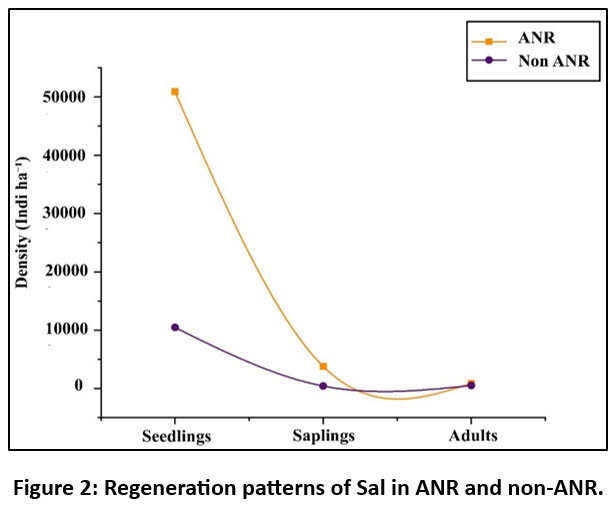
The regeneration status of Sal varied between ANR and non-ANR forests. ANR showed good regeneration with a higher density of seedlings (50,869 ± 11.61 Indi ha-1), followed by saplings (3795 ± 14.81 Indi ha-1), and adult trees (882 ± 12.23 Indi ha-1). In non-ANR, the regeneration was fair, with seedlings being the most abundant (10,443 ± 10.09 Indi ha-1), adults (500 ± 11.13 Indi ha-1) intermediate, and saplings (419 ± 12.55 Indi ha-1) least abundant. Overall, all stages had lower in non-ANR. A two-way ANOVA (Table 1) confirmed significant effects of forest type, developmental stage, and their interaction on regeneration (p < 0.001), indicating that assisted natural regeneration practices enhance seed germination, seedling survival and sapling growth.
Table 1: Two-way ANOVA test among different developmental stages in ANR and non-ANR forests.
Source | Sum of Squares | df | Mean Square | F | p-value |
Forest Type | 24.89 | 1 | 24.89 | 1377 | < 0.001 |
Developmental Stage | 82.60 | 2 | 41.30 | 2285 | < 0.001 |
Interaction | 42.52 | 2 | 21.26 | 1176 | < 0.001 |
Within (Error) | 0.43 | 24 | 0.018 | - | - |
Total | 150.44 | 29 | - | - | - |
The graphical representation in Fig. 2 further illustrates the comparison of seedling, sapling and adult populations between ANR and non-ANR, highlighting the differences in regeneration patterns.
 | Figure 2: Regeneration patterns of Sal in ANR and non-ANR.
|
The density- diameter relationship of Sal, is depicted in Fig. 3, revealed a higher population in the >5 cm diameter class in both ANR and non-ANR. However, non-ANR showed a secondary peak in the 70 cm and above diameter classes, whereas ANR had a declining trend with increasing diameter classes, representing a reverse J- shaped curve.
 | Figure 3: Density- diameter distribution of Sal in ANR and non-ANR.
|
Discussion
Our study reveals a significant increase in seedling, sapling, and adult tree density in ANR compared to non-ANR site, indicating enhanced regeneration potential in ANR site. This improvement is likely attributed to the favourable edaphic conditions in ANR, including acidic soil, adequate soil moisture, and high nutrient availability, which collectively support Sal growth and regeneration.16 These findings align well with the previous research highlighting the importance of favourable edaphic factors for Sal regeneration.17-18 Effective forest management further promotes seedling establishment through practices like regeneration felling and weeding, which increase light intensity and reduce competition.19 In non-ANR site, Sal regeneration faces significant challenges. Despite high seedling density, the number of saplings decline sharply, likely due to intense competition for resources and biotic disturbances.20 Additionally, short seed viability21 and seed collection by local communities for economic purposes worsen the situation, ultimately limiting the seedling transition into adult stage. This resonates with the prior study, showing a negative correlation between disturbance level and Sal seedling and sapling density, suggesting that overexploitation of forest resources and grazing likely contributed to reduced species richness.22
ANR demonstrated sustainable regeneration , characterized by an inverse J- shaped diameter at breast height (DBH) distribution, where tree density decreased exponentially with increasing DBH. This pattern, supported by a high seedling density followed by saplings and adult trees, indicates continuous regeneration.23 In contrast, non-ANR deviated from the inverse J- shaped curve, with a secondary peak in tree density among larger diameter classes (> 70 cm) and higher tree density than saplings, corroborating earlier findings that human disturbances in forests can alter size- class distributions and disrupt regeneration patterns.24
Building on these findings, both ANR Sal forest and naturally regenerating (non-ANR) Sal forest promote ecosystem resilience and biodiversity, but they differ in their approach. Non-ANR also promotes local genetic adaptation and self- organizing processes,25 but it is vulnerable to exploitation and disturbances by local people. ANR, on the other hand, has some limitations, including dependence on sufficient natural regeneration, slower growth rates, and labour- intensive initial phases, and is often overlooked by policymakers favouring active tree planting. However, ANR offers several advantages like cost- effectiveness, promotion of native species and increased carbon storage,26 making it a promising approach for forest restoration.
Conclusion
The study demonstrates that Assisted Natural Regeneration (ANR) significantly enhances Sal forest regeneration compared to non-ANR. ANR forest shows good regeneration with a reverse J- shaped diameter distribution, indicating healthy forest ecosystem. In contrast, non-ANR forest has fair regeneration, limited by biotic disturbances and resource competition. The findings underscore the potential of ANR in promoting the long- term sustainability of Sal forests, making it a valuable strategy for forest conservation management.
Acknowledgement
The authors would like to thank to the Department of Environmental Science, Kanya Gurukul Campus, Gurukul Kangri (Deemed to be University), Haridwar. We are grateful to the Forest Range Officer, Nandhaur for granting the permission for the research work and special thanks to Forest Guard and wildlife staff for the help during fieldwork. Dr. B. D. Joshi, former Divisional Logging Officer is also acknowledged for his valuable inputs.
Funding Sources
The author(s) received no financial support for the research, authorship, and/or publication of this article.
Conflict of Interest
The authors do not have any conflict of interest
Data Availability Statement
The manuscript incorporates all datasets produced or examined throughout this research study.
Ethics Statement
This research did not involve human participants, animal subjects, or any material that requires ethical approval.
Informed Consent Statement
This study did not involve human participants, and therefore, informed consent was not required.
Permission to reproduce material from other sources
Not Applicable
Author Contributions
Neetu Joshi: Conceptualization, Methodology, Project administration, Writing – Original draft, Writing – Review & Editing, Investigation, Visualization, Software and Statistical Analysis.
Namita Joshi: Validation and Supervision.
References
- Champion H.G., Seth S.K. Revised survey of the forest types of India. New Delhi: Publication Division, Govt. of India; 1968.
- Kongkham B., Khanduri V. P., Rawat D., Singh B., Riyal M., and Ahmad T. Community structure, regeneration status, carbon sequestration potential and soil properties in Shivalik Sal forests of Uttarakhand, India. Advances in Bioresearch. 2021; 12(4):206-215. 10.15515/abr.0976-4585.12.4.206215.
- Singh J.S., and Singh S.P. Forest of Himalaya: Structure, functioning and impact of man. Nainital: Gyanodya Prakashan; 1992.
- Gautam M.K., Manhas R.K., and Tripathi A.K. Plant species diversity in unmanaged moist deciduous forest in north India. Current Science, 2014; 106: 277-291.
- Deshpande A. Natural Regeneration of Sal (Shorea robusta) in Protected and Unprotected Forests of Kalsi Forest Division, Uttarakhand, India. Dehradun: Forest Research Institute, Indian Council of Forestry Research and Education, (ICFRE); 2015.
- Tewari D.N. A Monograph on Sal (Shorea robusta Gaertn. F.). Dehradun: International Book Distributors; 1995.
- Sahu K., and Naithani S.C. Low temperature induced alteration in growth pattern and mortality in young sal (Shorea robusta) seedlings. Journal of Tree Sciences, 2005; 24 (2): 69-78.
- Tripathi R.S., and Khan M.L. Regeneration dynamics of natural forests- A review. Proceedings of the Indian National Science Academy, 2007; 73(3):167-195.
- Chauhan D.S., Singh B., Chahun S., Dhanai C.S., and Todaria N.P. Regeneration and plant diversity of natural and planted Sal (Shorea robusta Geartn. F.) forests in the Terai-Bhabhar of Sohagibarwa Wildlife Sanctuary, India. The Journal of American Science. 2010; 6(3):32-45.
- Shankar, U. A case of high tree diversity in a Sal (Shorea robusta) dominated lowland forest of Eastern Himalaya: Floristic composition, regeneration and conservation. Current Science. 2001; 81(7):776-786.
- Gautam K.H., and Devoe N.N. Ecological and anthropogenic niches of Sal (Shorea robusta Gaertn. f.) forest and prospects for multiple-product forest management- a review. Forestry. 2006; 79(1):81-101. https://doi.org/10.1093/forestry/cpi063.
CrossRef - Singh V., Dhawan V. K., Negi A., and Kumar P. Impact of Sal (Shorea robusta) ANR (Assisted Natural Regeneration) in Shiwalik Forests of Uttarakhand. Environment and Ecology. 2023; 41(3D):2080-2088. https://doi.org/10.60151/envec/WLUU5416.
CrossRef - Shono, K., Cadaweng, E. A., and Durst, P. B. Application of Assisted Natural Regeneration to Restore Degraded Tropical Forestlands. Restoration Ecology. 2007; 15(4) : 620-626.
CrossRef - Chauhan P.S., Negi J.D.S., Singh L., and Manhas R.K. Regeneration status of sal forests of Doon valley. Annals of Forestry. 2008; 16(2):178-182.
- Maren I.E., Karki S., Prajapati C., Yadav R.K., and Shrestha B.B. Facing north or south: Does slope aspect impact forest stand characteristics and soil properties in a semiarid trans-Himalayan valley? Journal of Arid Environments. 2015; 121:112–123. https://doi.org/10.1016/j.jaridenv.2015.06.004.
CrossRef - Joshi N., and Joshi N. Seasonal Variations of Soil Nutrient Dynamics in Sal Forests under Two Management Regimes in Nandhaur Range, Nainital, Uttarakhand. Journal of Environment & Bio-sciences. 2024; 38(1):23-27.10.59467/JEBS.2024.38.23.
CrossRef - Awasthi A., Bhandari S. K., and Khanal Y. Does scientifc forest management promote plant species diversity and regeneration in sal (Shorea robusta) forest? A case study from Lumbini collaborative forest, Rupandehi, Nepal. Banko Janakari. 2015; 25(1):20–29. https://doi.org/10.3126/banko.v25i1.13468.
CrossRef - Gautam M.K., Manhas R.K., and Tripathi, A.K. Plant species diversity in unmanaged moist deciduous forest of Northern India. Current Science. 2014; 106(2):277-287.
- Poudel P., and Devkota A. Vegetation structure and species diversity in community managed Sal (Shorea robusta) forest of Tanahun district, Nepal. International Journal of Ecology and Environmental Sciences. 2022; 48(2):165-175.
CrossRef - Raj, A. Population structure and regeneration potential of Sal dominated tropical dry deciduous forest in Chhattisgarh, India. Tropical Plant Research. 2018; 5(3):267-274. 10.22271/tpr.2018.v5.i3.034.
CrossRef - Jackson J.K. Manual of afforestation in Nepal. Nepal: Nepal- United Kingdom Forestry Research Project; 1987.
- Chapagain, U., Chapagain, B. P., Nepal, S., and Manthey, M. Impact of disturbances on species diversity and regeneration of Nepalese Sal (Shorea robusta) forests managed under different management regimes. Earth. 2021; 2(4): 826-844.
CrossRef - Khamyong S., Lykke A. M., Seramethakun D., and Barfod A. S. Species composition and vegetation structure of an upper montane forest at the summit of Mt. Doi Inthanon, Thailand. Nordic Journal of Botany. 2003; 23(1):83-97. https://doi.org/10.1111/j.1756-1051.2003.tb00371.x.
CrossRef - Sharma, K. P., Bhatta, S. P., and Lamsal, S. K. Species diversity and regeneration status of community-managed hill sal (Shorea robusta) forest in Central Nepal. Current Science. 2020; 119(1): 83-92.
CrossRef - Chazdon, R. L., and Guariguata, M. R. Natural regeneration as a tool for large-scale forest restoration in the tropics: prospects and challenges. Biotropic. 2016; 48(6): 716-730.
CrossRef - Baretha, G., Maitry, A., and Shah, P. Assisted Natural Regeneration: A Tool for Ecosystem Service Benefits to Achieve Sustainable Development Goals. In: Patil G. Ecosystem services with sustainable development. New Delhi: International Research Academic Publication; 2022: 91-99.