
Smart Soil Solutions: Eco-Efficient Stabilization of Expansive Black Cotton Soil Using Geosynthetics
Renu Tiwari
*
 and Manoj Kumar Tiwari
1
Department of Civil Engineering,
Dr. C.V. Raman University,
Bilaspur,
Chhattisgarh
India
http://dx.doi.org/10.12944/CWE.20.2.18
Copy the following to cite this article:
Tiwari R, Tiwari M. K. Smart Soil Solutions: Eco-Efficient Stabilization of Expansive Black Cotton Soil Using Geosynthetics. Curr World Environ 2025;20(2). DOI:http://dx.doi.org/10.12944/CWE.20.2.18
Copy the following to cite this URL:
Tiwari R, Tiwari M. K. Smart Soil Solutions: Eco-Efficient Stabilization of Expansive Black Cotton Soil Using Geosynthetics. Curr World Environ 2025;20(2).
Download article (pdf)
Citation Manager
Publish History

Introduction
One of the problems of the environment during the development of any infrastructure is usually the poor soil. To advance the infrastructure, soil engineering properties should be improved by either compacting the soil with the help of a physical method or using some chemicals.1 Every soil additive to be applied when undertaking soil stabilization can be classified into three groups namely the chemical additives, cementitious as well as non-cementitious additives. An example of non-cementitious stabilizers is sand, rock dust, quarry dust, and fly ash.2 and, cement and lime are cementitious additives. Top among these chemical additives of the last category are KCl, NaOH, MgCl2, CaCl2 and AlCl3.3 Geosynthetics are one of the most flexible and inventive solutions in the context of modern construction and engineering, significantly contributing to the number of challenges solved and transforming the established ways of doing things. Geosynthetics are flexible and innovative applications that modify the traditional methods and cope with a great variety of concerns in the high-tempo environment of the modern engineering and production industry.4 Taking into consideration the history of geosynthetics, it is important to consider the turning points and the discoveries which created the area. The initial thought regarding geosynthetics had to do with the dissatisfying outcomes of the conventional building materials and building technologies. The latter have become an inalienable element of virtually any construction project over the course of time.5 The use of geosynthetics in geotechnical and environmental engineering has grown over the past four decades. Over this period, these products have helped designers and contractors solve specific engineering problems that would have been difficult or costly to address using traditional construction materials.6 There are many applications of geosynthetics in geotechnical engineering. Their origin is rich, beginning modestly as the need for effective solutions in soil stabilization, erosion control, and environmental protection led to their initial use in these areas. Geotextiles, geomembranes, geogrids, and other geosynthetics have undergone significant development over the years, with several revolutionary advancements.7 Notable events, such as the invention of woven geotextiles in the 1950s, have also contributed to the expansion of geosynthetics' applications. They became widely used as affordable, powerful, and eco-friendly alternatives in construction, where prior design options were limited.8 Geosynthetics are mostly made from petrochemical-based polymers (plastics) that are biologically nonreactive and resistant to breakdown by bacteria or fungi. Although most are chemically inert, petrochemicals can damage some types, and most are somewhat susceptible to ultraviolet light (sunlight).9 The durability of geosynthetic materials depends on several factors, including design, construction, material quality, age, environmental conditions, and loads. Factors considered at the termination of their service life include weathering and load-carrying capacity. They degrade due to temperature stress, biological, chemical, mechanical attack, and ultraviolet exposure.21
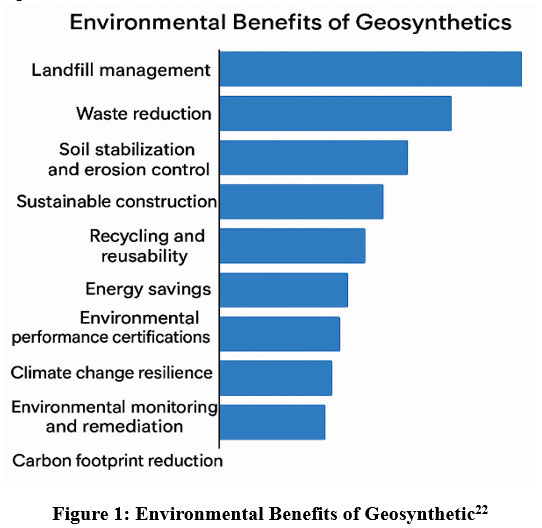 | Figure 1: Environmental Benefits of Geosynthetic22
|
Literature Review
Large-scale pull-out testing was conducted on geogrid specimens covered with soil. Conversely, longitudinal and transverse reinforcement bone pull-out tests were prepared. In applying geogrids in the current study, the mechanism's nature specifically influences a vital aspect of the interfacial shear strength along the length.10 It is according to the results of infiltration tests on geosynthetics and sand in layers and drainage that there was the same behaviour of using geosynthetics as layers and drainage in the saturated soil as that of conventional layers and sand.11 When the soil is local and the soil needs reinforcement and strengthening of thin soil layers, like in the case of using geotextiles and geogrids, fiber reinforcement is the appropriate solution.12 Although this reduced strength was brought about initially along the fibre-soil interface, the outcome of this test indicates that the influence of fibres on the pore pressure under CU testing could yield greater sufficient strength.13 Geosynthetic can be used as a reflective crack treatment in the asphalt layers which create a separation between the layers by providing an anchoring support, they stabilize roads base as well as the soft sub grades, and they are capable of providing horizontal drainage.14 Furthermore, reinforcement was carried out to alleviate the cracks in a longitudinal direction in a pavement built on a highly plastic, expansive clay base. It was found that the use of geogrids has the capability of reducing the amount of longitudinal cracking on the pavement section when compared to the pavement sections without geogrid usage, which will display serious cracking.15 Behaviour of the shear strength is high in the usage of Geogrid in contrast to Geotextile regarding layers and interfaces.16 Result of all test methods (field testing, lab testing, numerical study), prove that geosynthetics play a considerable role in the performance of pavements; a test is required to become more empirically designed.17 Tensile stresses will be created in the geogrid located in the pavement layer when vehicles load the geogrid. This will reduce the flexure on the pavement- after that time of road service is increased with the same traffic.18 Geosynthetic clay liners provide a mixture of clay and geotextiles. Such liners are necessary in their containment applications, such as landfills, and scholars seek to understand how they might enhance their permeability and durability. The use of geosynthetics for ground improvement is a discussed issue, especially in areas where soil conditions are challenging. Scientists are investigating new methods to stabilize unstable soils and reduce sinking.19 Improvement of the overall engineering properties of the ground. The complex numerical modelling and simulation tools are aiding in predicting the behaviour of geosynthetic-stabilized structures accurately. 20
Objectives of this Research
The primary objective of this study is to evaluate the effectiveness of various geosynthetic materials—namely Geotextile, Geogrid, Geocell, Geomembrane, Geo-mat, and Geo-composite—in enhancing the geotechnical properties of black cotton soil. Specific goals include:
Improving the California Bearing Ratio (CBR) and Unconfined Compressive Strength (UCS) of black cotton soil.
Reducing Swelling Pressure and Swell Index, which contribute to soil instability.
Increasing soil Cohesion and Friction Angle to improve overall shear strength.
Comparing the performance of different geosynthetic types across varying inclusion percentages (0.5% to 3.0%).
To investigate the microstructural and mineralogical changes in black cotton soil reinforced with various geosynthetic materials—namely geotextile, geogrid, geocell, geonet, and geomembrane—using Scanning Electron Microscopy (SEM) and X-Ray Diffraction (XRD) analyses.
Types of Geosynthetics
Geosynthetics is a large, highly diversified group of materials designed to address various engineering and construction challenges. Every category of geosynthetic material has a different purpose and use universe.
Geotextiles
The essence of geosynthetic material is that it is highly connected to porous, robust, thin, and flexible planar or sheet-like materials made of fibres.23 The composition of fibers is polyester, polypropylene, polyamide, etc, which leads to very robust as well as thin fibers, either of which can be woven together using special machines called Woven-geotextile, or linked together through making mechanical, chemical, or thermal bond between fibers, called Non-Woven geo-textile.24 Added as geotextiles to the soil, geotextiles have the properties of separation, drainage, reinforcement, and filtration. Owing to their characteristics, they are implemented in numerous civil work projects such as roadways, landfills, drainage works, erosion controls, and railways, among many other uses.25 Under geotextile, pavements become tougher, stiffer, and the durability of pavements gets better, reducing the price of maintaining the infrastructure, and also increasing the utility of the infrastructure.26 Studies have shown that as the depth of geotextile placement increases, the strength of the soil improves up to a specific limit. Beyond this point, further increasing the depth does not result in any significant increase in soil strength.27
Geomembrane
Artificial sheets Geomembranes are sheets that are utilized in engineering works as a divider. It is a thin and robust and a very low permeability synthetic membrane that can help in controlling the flow of liquids such as serving as a liner in land-fills and is to create a barrier against fluid movement. Facilities which will help to reduce soil expansion because the soil has limited contact with water. It protects the dams and coffer dams.28 Such materials are highly impermeable; as a result, they can intuitively manage the bad pollutants, diffusion, and they are productive in liner as well as control systems, in radio-actives and other hazardous fluid waste. So equipped with all this property and applications, geo-membranes are costly in comparison with other geosynthetics. It can be employed during numerous water conservation initiatives and projects, i.e., the construction of ponds, lakes, and canals.29 Some of their benefits compared to conventional barriers are: they last longer, can be installed quickly, are economical to install, they are highly deformable, and do not need a lot of maintenance unlike the conventional barriers, they also enhance the hydraulic efficiency of a system. The geomembrane system is popular all over the world, because of these benefits.30
Geogrids
It is a product which is laid on a web or grid application. They have a large opening also referred to as the aperture. The base materials are polyester, polyvinyl, and polyethylene in producing polyester. They are produced through processes such as extrusion and weaving.31 The principle behind its working is in a matter that the materials are tensive-strong thus will be able to distribute and shift the weight of the load readily over big sections of the surface ground. Which also in a way, it enhances soil stability. It is used in sub bases of pavements because it strengthens them. It is applicable in dams, retaining walls, and in other uses but not in road pavements. Additives like lime with cement geogrid enhances the soil properties mechanically.32,33
Geomates
They are also much like Geogrid. They are built by overlapping or joining of fibers at sharp angles reassembling them as a net-like structure.34 Geonets are made from thermoplastic polymers, which allow them to be readily molded into various forms. Their durability makes them suitable for supporting heavy objects. Utilized for their hydraulic properties, such as the transfer of fluids, which is employed in various fields, including foundations, landfills, pavements, and drainage areas.35
Geocells
These structures, commonly referred to as cellular confinement systems, are three-dimensional honey-comb configurations made from high-density polyethylene (HDPE) or similar polymers. They are extensively used in civil engineering for applications such as soil stabilization, load-bearing support, and erosion prevention.36 These structures consist of inter-connected cells that, when filled with soil, aggregate, or concrete, form a solid, concrete-like system. Geo-cells are of very low weight and this produces a great shear strength and lateral support that makes them distribute more uniform load. It prevents weakening of the soil. They are generally used in road and railway construction to improve bearing capacity, reduce soil settlement, and enhance the over-all performance of pavements.37 They are also used in the same way in slope stabilization to reduce soil wash-out and landslides, and landslides, as well as last soil movements across retaining walls. There is already a research drive both worldwide to see how best it can be optimized in terms of performance, life expectancy and environmental-friendliness by designing it in terms of cell size, cell wall height and material characteristics.38
Geo-Composite
A Geo-composite is a commercial term comprising materials designed to combine two or more types of geosynthetics into a single product with improved properties and application functions. These components usually are geotextiles, geogrids, geomembranes, or other specialized geosynthetic materials. A geo-composite offers enhanced functionality in filtration, drainage, reinforcement, or as a barrier. They must be customized to address the specific engineering problems in civil or environmental engineering. Geo-composites have become immensely important in modern-day geotechnical engineering and environmental protection since they offer adaptable techniques for ground-water control, waste control, infra-structure development, and erosion control.39
Black Cotton Soil
Soil rich in clay is known as black cotton soil, or BC soil. Black cotton soil, also known as BC soil, gets its dark hue from a relatively low amount of titanium oxide. Black cotton soil (BC soil) has a high concentration of clay, a kind of clay that is structurally similar to montmorillonite and appears black or blackish gray. Soils that expand as their moisture content increases are known as expansive soils. Soils obtain their swelling behaviour from montmorillonite, the primary clay mineral. Swelling soils and black cotton soils are other names for these types of soils. Because the subgrade weakens during the monsoon, structures built on Black cotton soil (BC soil) are vulnerable to the road's surface undulations.40 Depending on the region, anywhere from 40% to 60% of Black cotton soil consists of particles smaller than one micrometre. liquid limit, the volume change can be as high as 200 to 300 percent, resulting in a swelling pressure of 8 to 10 kPa. Black cotton soil, also known as BC soil, is characterized by a high degree of swelling and shrinking and a feeble bearing capacity, as this consideration indicates. This makes it an unsuitable material for use as a road base due to its undesirable electrical conductivity. The soils comprised of Black Cotton normally have CBR values of about 2 to 4 percent wet in a laboratory condition. The plan of designing flexible pavement is an over-grazing in the layer of pavement because the CBR of the black cotton soil possesses a significantly low bearing capacity. A significant amount of research and development has been invested in exploring methods to improve the strength characteristics of black cotton soil utilizing recent technology. The construction of foundations for structures on black cotton soils poses a significant challenge to civil engineers.40
Table 1: Properties of Black Cotton Soil
S. No. | Property | Value |
1 | “Gravel” | 0% |
2 | “Sand | 12% |
3 | “Silt” | 25% |
3 | “Clay” | 63% |
4 | “Liquid Limit” | 82.60% |
5 | Plastic Limit | 29.20% |
6 | Plasticity Index | 53.40% |
7 | Shrinkage Limit | 11.31% |
8 | “Soil Classification” | CH |
9 | “Specific Gravity” | 2.33 |
10 | “Differential Free Swell” | 74% |
11 | “Optimum Moisture Content” | 38% |
12 | “Maximum Dry Density (BSL)” | “1.29 gm/cc” |
13 | “Maximum Dry Density (BSH)” | “1.478 gm/cc” |
14 | “AASHTO Classification” | “A-7-6" |
15 | “Colour” | Black |
16 | “pH” | 7.15 |
17 | “CBR Value (Soaked, BSL)” | 4 |
17 | “CBR Value (Soaked, BSH)” | 5.98 |
18 | “CBR Value (Unsoaked, BSL)” | 9.2 |
19 | CBR Value (Unsoaked, BSH) | 11.4 |
Materials and Methods
The method of this study involves an efficient approach to evaluate the effectiveness of various geosynthetics in stabilizing black cotton soil. The process begins with the collection of black cotton soil samples, which are then subjected to preliminary characterization to determine key physical and geotechnical properties, including parameters like particle size distribution, specific gravity, Atterberg limits, plasticity index, and classification. 5,000 g (5 kg) of dry black cotton soil is used for each lab sample.41
Once the baseline properties are established, “different types of geosynthetics—namely Geotextile, Geogrid, Geocell, Geomembrane, Geo-mat, and Geo-composite—are introduced into the soil in varying percentages ranging from 0.5% to 3.0% by weight. Each mixture is carefully prepared to ensure uniform blending of geosynthetics with the soil mass”.
The modified soil samples are then subjected to standard laboratory tests to evaluate performance improvements. These include:
The Maximum Dry Density (MDD) and Optimum Moisture Content (OMC) at Standard Proctor Test are to be determined.
California Bearing Ratio (CBR) test to assess load-bearing capacity.
Unconfined Compressive Strength (UCS) test to measure shear strength without lateral confinement,
Swelling Pressure and Swell Index tests to evaluate the soil's expansive behaviour,
Direct Shear or Triaxial tests are applied to find Cohesion and Friction Angle, which measure the soil’s shear resistance.
The various microstructural and mineralogical alterations that black cotton soil undergoes when it is stabilized with different geosynthetic materials like geotextile, geogrid, geocell, geonet, and geomembrane. To accomplish this, representative samples of untreated black cotton soil and soil reinforced with each type of geosynthetic were prepared under controlled laboratory conditions. These prepared samples were then subjected to microstructural analysis by Scanning Electron Microscopy (SEM) to observe changes in the soil fabric, particle arrangement, and interface interaction with geosynthetics.
X-Ray Diffraction (XRD) analysis was also carried out to assess changes in mineralogical composition and crystalline phases with particular attention to montmorillonite, kaolinite, and quartz. XRD results in the light of intensity variations in the said. The comparative evaluation of untreated and treated soils gave insight into which treatment was more effective in improving soil behaviour. This integrated approach lays the foundation for the overall objective of evaluating the impact of geosynthetics on enhancing the mechanical and structural properties of expansive soils, making them suitable for geotechnical engineering applications.42
Data generated from these tests are analysed and compared with results obtained from non-treated soil to measure precisely the improvement realized through geosynthetic stabilization. The analysis also helps in knowing which type and dosage of geosynthetic would work best in improving each soil parameter. Such a methodology ensures a perfect evaluation of geosynthetic performance in alleviating the problematic nature of black cotton soil.43
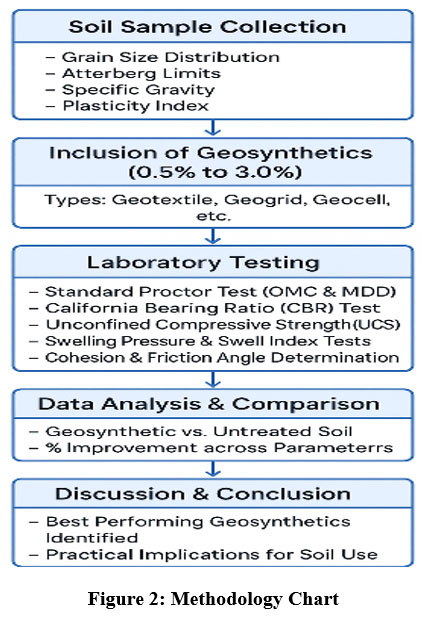 | Figure 2: Methodology Chart
|
To calculate the weight of geosynthetic pieces to be added to soil, use the formula: Table 2 represents the weight of geosynthetic in black cotton soil at different percentages
Weight of geosynthetic (g)= (100/Percentage %) ×Weight of dry soil (g)
Table 2: Weight Formation
Percentages (%) | Formula | Geosynthetic Weight (g) |
0.5% | (0.5 / 100) × 5000 | 25 g |
1.0% | (1.0 / 100) × 5000 | 50 g |
1.5% | (1.5 / 100) × 5000 | 75 g |
2.0% | (2.0 / 100) × 5000 | 100 g |
2.5% | (2.5 / 100) × 5000 | 125 g |
3.0% | (3.0 / 100) × 5000 | 150 g |
Results
Grain Size Distribution
It’s a particle size distribution, a fundamental soil property that significantly influences its engineering behaviour. It describes the relative proportions of different-sized particles present in a soil sample. This analysis is typically conducted through mechanical sieving for coarse particles and sedimentation methods for finer fractions. Understanding the distribution of grain sizes is crucial for soil classification, assessing permeability, determining compaction characteristics, and predicting shear strength.
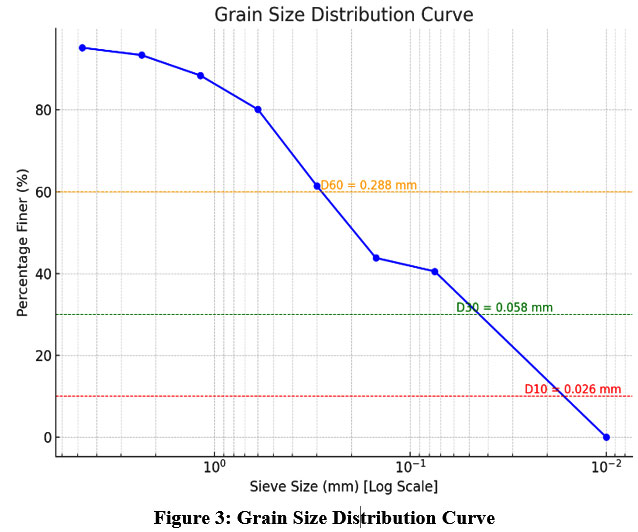 | Figure 3: Grain Size Distribution Curve
|
Specific Gravity
Specific gravity of the normal expansive soil is determined under the IS codes standards. But we are utilized in measuring a gravity by means of the pyrometer examination. It may be calculated with the help of real mass of every constituent and its specific gravity. Table 3 shows Black cotton soil's specific gravity.
Table 3: Black cotton soil's specific gravity
Sample No. | Sample 1 | Sample 2 | Sample 3 |
Empty pycnometer (M1) | 633 gm | 633 gm | 633 gm |
Pycnometer with dry soil (M2) | 833 gm | 833 gm | 833 gm |
Pycnometer filled with water (M4) | 1476 gm | 1475 gm | 1476 gm |
Pycnometer with soil and water (M3) | 1579gm | 1585 gm | 1587 gm |
Specific Gravity | 2.06 | 2.22 | 2.24 |
The specific gravity (shows 2.22) of black cotton soil was determined using the pycnometer method. Three samples were tested, and the specific gravity values obtained were 2.06, 2.22, and 2.24, respectively. These values were calculated using the standard formula, which involves the mass of the empty pycnometer, the pycnometer filled with dry soil, the pycnometer filled with water, and the pycnometer filled with both soil and water. The variation in specific gravity among the samples may be due to slight differences in soil composition or measurement”. These results indicate that the soil is within the typical range for fine-grained soils.
Plastic Limit
The plastic limit is the Atterberg limit employed to define the behaviour and the consistency of fine-grained soils. It is the moisture content of the soil where it adjusts between a plastic state of existence and semi-solid phase of existence”. Investigation of the plastic limit is essential in determining the plasticity of the soil with effects on the workability, stability, and bearing capacity of soil regardless of the geotechnical applications. Table 4 is emphasizing the plastic limit of geosynthetic.
Table 4: Plastic Limit of Geosynthetic
Percentage of Geo-synthesis (%) | Geotextilie PI (%) | Geogrid PI (%) | Geocell PI (%) | Geomembrane PI (%) | Geo-mat PI (%) | Geo-composite PI (%) |
0.5 | 31.8 | 32.2 | 32.5 | 33 | 32.5 | 32 |
1.0 | 29.4 | 28.8 | 29 | 29.5 | 29 | 29.2 |
1.5 | 27.2 | 25.6 | 26.3 | 26.8 | 26.3 | 26.5 |
2.0 | 24.1 | 22 | 23.5 | 23 | 23.5 | 23 |
2.5 | 22.5 | 19.5 | 21 | 21.5 | 21 | 21.5 |
3.0 | 20.9 | 17 | 18.5 | 19 | 19 | 19 |
From table 4, the black cotton soil’s plasticity index (PI) was evaluated by varying inclusion percentages (0.5% to 3.0%) of different geosynthetic materials—Geotextile, Geogrid, Geocell, Geomembrane, Geo-mat, and Geo-composite. The results showed a consistent reduction in PI values with increasing inclusion levels for all types of geosynthetics. At a 0.5% inclusion rate, the PI values ranged from 31.8% to 33%. At a 3.0% inclusion rate, the values decreased significantly, ranging from 17% to 20.9%. Among the materials tested, Geogrid demonstrated the most substantial reduction in PI, indicating its higher effectiveness in minimizing the plasticity of black cotton soil. This trend confirms that geosynthetics can effectively stabilize expansive soils by reducing their plasticity.44,45
.jpg) | Figure 4: Plastic Limit of Geosynthetic illusion on Plasticity Index
|
Standard Proctor Test
The correlation between the maximum dry unit weight and optimum moisture content of Black Cotton soils which is stabilized using varied percentages of geosynthetics is as outlined below. The figure illustrates the data of MDD and OMC. This depicts the correlation that exists between Maximum Dry Density (MDD) and Optimum Moisture Content (OMC) of geosynthetics stabilized half-filled soils of black cotton with various types of geosynthetics namely; Geotextiles, Geogrid, Geocell, Geomembrane, geomats, and geocomposite. The OMC values are ranged between 1.552 and 1.583 percent on the horizontal axis/ Y axis whereas the MDD values are measured in g/cm 3 and they range between 18 to 24 g/cm 3. Comparison of the black cotton soil reinforced with various types of geosynthetic indicates that there is a certain pattern of performance about the MDD at different levels of OMC. Among geosynthetics, Geotextile consistently demonstrates the highest MDD values across all OMC levels, peaking around 23. 3 g/cc at 1.552% OMC and decreasing to approximately 21.5%. 5 g/cc at 1. 583% OMC. This indicates excellent reinforcement and compatibility with black soil, making it the most effective material for compaction. Geogrid initially showed a relatively high MDD of 22. 7 g/cc at a low OMC declines sharply as the moisture content increases, reaching approximately 19.9. 9 g/cc at 1 1.583% OMC. This suggests it performs better under lower moisture conditions. Geocell also performs well initially, with an MDD just below 23 g/cc at 1.552% OMC, but experiences a moderate decrease in density as the moisture content rises, ultimately reaching 20.2 g/cc. Geomembrane starts strong but also shows a noticeable drop in MDD at higher OMC, indicating reduced effectiveness in wetter conditions. Geo-mat follows a similar pattern to Geotextile, maintaining relatively high MDD values throughout, suggesting good bonding and reinforcement ability. The geo-composite shows stable but slightly lower MDD values compared to Geotextile and geomat, offering moderate performance across all moisture levels.46
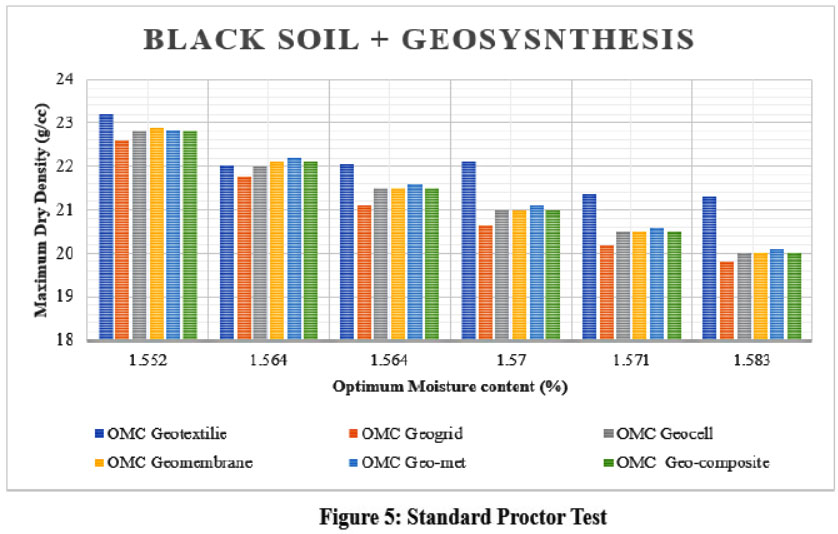 | Figure 5: Standard Proctor Test
|
California Bearing Ratio
The data provided shows the California Bearing Ratio (CBR) values for black cotton soil stabilized with various types of geosynthetics at different inclusion percentages ranging from 0.5% to 3.0%”. The CBR values indicate the load bearing capacity of the black cotton soil, which increases with the addition of geosynthetic content.47 Table 5 represents the CBR value of the geosynthetic
Table 5: CBR value of geosynthetic
Percentage of Geo-synthesis (%) | Geotextile CBR (%) | Geogrid CBR (%) | Geocell CBR (%) | Geomembrane CBR (%) | Geo-mat CBR (%) | Geo-composite CBR (%) |
0.5 | 3.59 | 3.7 | 4 | 4.2 | 4.1 | 4.5 |
1.0 | 5.19 | 5.3 | 5.6 | 5.8 | 5.7 | 6 |
1.5 | 6.54 | 6.9 | 7.1 | 7.3 | 7.2 | 7.5 |
2.0 | 7.82 | 8.4 | 8.5 | 8.8 | 8.6 | 9 |
2.5 | 9.57 | 9.9 | 10 | 10.3 | 10.1 | 10.5 |
3.0 | 11.01 | 11.4 | 11.5 | 11.8 | 11.5 | 11.8 |
From Figure 6, the CBR values of black cotton soil reinforced with various geosynthetics show a positive correlation with the percentage of inclusion. At each increase from 0.5% to 3.0%, all geosynthetics significantly enhance the soil's load-bearing capacity. Among the materials tested, the Geo-Composite consistently demonstrates the highest CBR values, reaching 11.8% at a 3.0% inclusion, indicating superior performance due to its combined structural and filtration properties. Geomembrane and Geo-cell follow closely, with final CBR values of 11.8% and 11.5%, respectively, reflecting excellent reinforcement capabilities. Geo-mat also performs well, matching Geo-cell with an 11.5% CBR at a 3.0% inclusion rate. Although slightly lower in performance, Geogrid and Geotextile still contribute significantly to soil strength, achieving 11.4% and 11.01%, respectively. Overall, the trend indicates that increasing the geosynthetic percentage enhances the subgrade strength, with Geo-composite and Geomembrane being the most effective, particularly at higher inclusion levels. These findings suggest that geosynthetic reinforcement is a highly effective method for enhancing the engineering properties of problematic soils, such as black cotton soil.
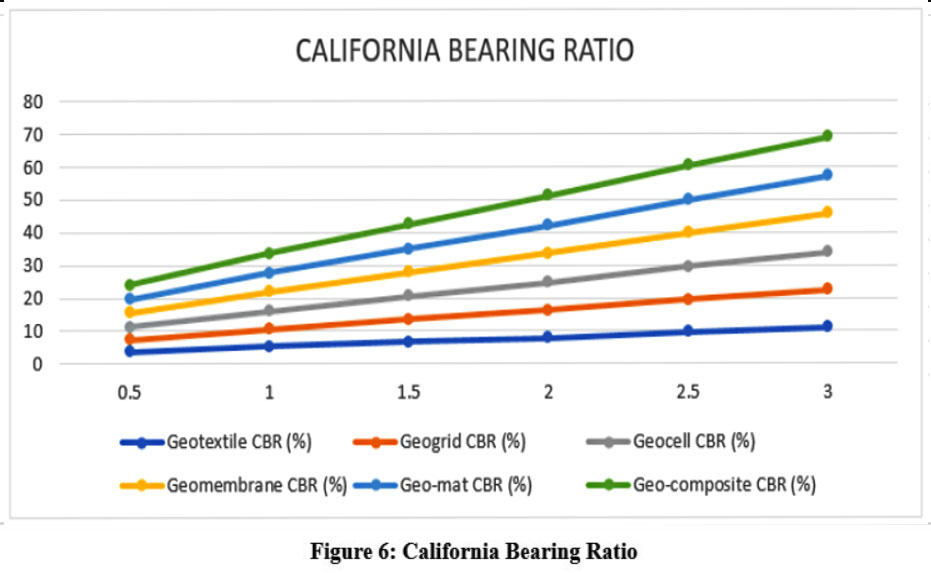 | Figure 6: California Bearing Ratio
|
Unconfined Compressive Strength
Unconfined Compressive Strength (UCS) values in kilopascals (kPa) for Stabilized black cotton soil with various geosynthetics at different inclusion percentages (0.5% to 3.0%) reveal a consistent and substantial increase in strength as the percentage of geosynthetic inclusion increases.48 Table 6 represents the UCS value of the geosynthetic.
Table 6: UCS value of geosynthetic
Percentage of Geo-synthesis (%) | Geotextile UCS (Kpa) | Geogrid UCS (Kpa) | Geocell UCS (Kpa) | Geomembrane UCS (Kpa) | Geo-mat UCS (Kpa) | Geo-composite UCS (Kpa) |
0.5 | 103.5 | 104.5 | 105.2 | 106.5 | 107.5 | 109.5 |
1.0 | 118.3 | 117 | 118.5 | 119 | 119.8 | 121.5 |
1.5 | 123.9 | 132.5 | 133.5 | 133 | 132 | 134 |
2.0 | 141.1 | 145 | 145.5 | 146.5 | 144 | 146 |
2.5 | 151.9 | 157 | 158 | 159 | 157 | 158.5 |
3.0 | 165.5 | 170.5 | 170 | 171 | 169.5 | 171 |
Figure 7 illustrates that at the lowest inclusion level of 0.5%, UCS values range from 103.5 kPa for Geotextile to 109.5 kPa for Geo-composite, suggesting that even a minimal addition enhances the soil's unconfined strength. As the dosage increases, the strength improvement becomes more pronounced. At 1.5%, Geo-composite (134 kPa), Geocell (133.5 kPa), and Geomembrane (133 kPa) outperform others, demonstrating strong soil reinforcement. From 2.0% onward, the UCS values escalate significantly, and by 3.0%, all materials surpass the 165 kPa mark. Geomembrane and Geo-composite lead with 171 kPa, followed closely by Geogrid (170.5 kPa) and Geocell (170 kPa). Geo-mat (169.5 kPa) and Geotextile (165.5 kPa) also show commendable performance, though slightly lower. This pattern indicates that geosynthetic reinforcement enhances the compressive strength of black cotton soil, with Geo-composite and Geomembrane offering the highest improvements across all inclusion percentages.49 Their effectiveness is likely due to their structural integrity, surface interaction with soil, and ability to resist deformation under unconfined conditions, making them highly suitable for soil stabilization in civil engineering applications.
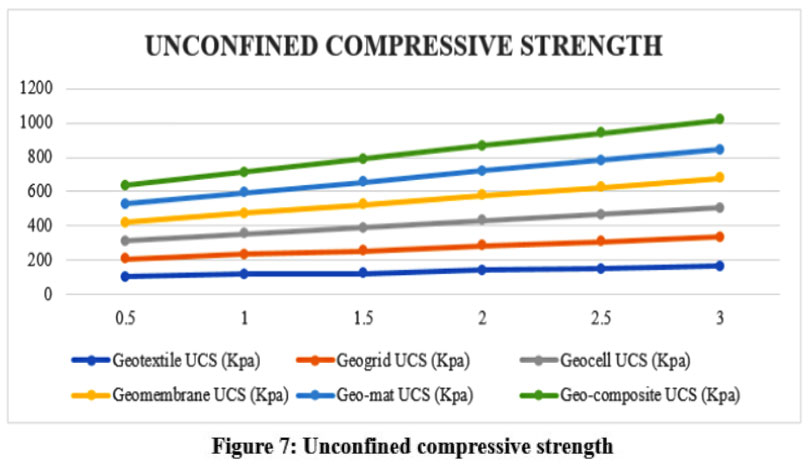 | Figure 7: Unconfined compressive strength
|
Swelling Pressure
The data on Swelling Pressure (SP) in kilopascals (kPa) for the stabilization of black cotton soil with Various types of geosynthetics across varying inclusion percentages (0.5% to 3.0%) demonstrates a clear and consistent decrease in swelling pressure as the percentage of geosynthetic material increases.50 Table 7 represents the Swelling pressure value of the geosynthetic.
Table 7: Swelling Pressure of Geosynthetic
Percentage of Geo-synthesis (%) | Geotextile SP (Kpa) | Geogrid SP (Kpa) | Geocell SP (Kpa) | Geomembrane SP (Kpa) | Geo-mat SP (Kpa) | Geo-composite SP (Kpa) |
0.5 | 10.54 | 10.7 | 10.2 | 10 | 9.9 | 9.5 |
1.0 | 9.33 | 9.2 | 8.8 | 8.5 | 8.4 | 8 |
1.5 | 8.13 | 7.7 | 7.3 | 7.1 | 7 | 6.5 |
2.0 | 6.8 | 6.2 | 5.8 | 5.7 | 5.7 | 5.2 |
2.5 | 5.52 | 5 | 4.5 | 4.4 | 4.3 | 4 |
3.0 | 4.31 | 3.9 | 3.5 | 3.3 | 3.2 | 3.1 |
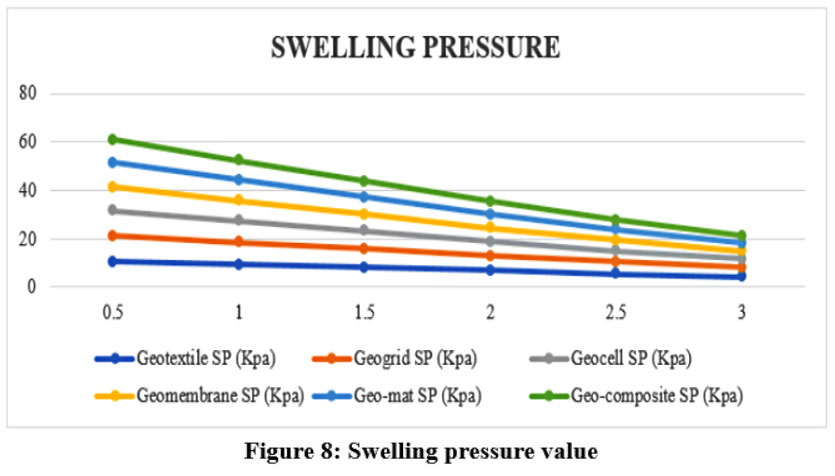 | Figure 8: Swelling pressure value
|
From Figure 8, the initial level of 0.5% inclusion shows the highest swelling pressure, with Geotextile exhibiting the greatest SP at 10.54 kPa, followed by Geogrid (10.7 kPa) and Geocell (10.2 kPa). As the geosynthetic content increases, there is a noticeable drop in SP values for all materials. At 1.5%, the SP values have decreased significantly, with Geo-composite showing the lowest pressure at 6.5 kPa, highlighting its superior ability to mitigate swelling. This trend continues, and at the highest inclusion level of 3.0%, all materials show substantially reduced swelling pressures, with Geo-composite again achieving the lowest at 3.1 kPa, followed by Geomembrane (3.3 kPa) and Geo-mat (3.2 kPa). This data confirms that geo-synthetics are very Used to control and reduce the swelling potential of expansive black cotton soil. Among the materials tested, Geo-composite consistently shows the lowest swelling pressures, making it the most effective in suppressing volumetric expansion, which is crucial for ensuring the long-term stability of structures built on expansive soils. Geomembrane and Geo-mat also perform well in this regard. Therefore, for applications where swelling control is critical, these materials, especially Geo-composite, are particularly recommended.
Swell Index
The data on swell index for black cotton soil stabilization with various types of geo-synthetics across varying inclusion percentages (0.5% to 3.0%) demonstrates a clear and consistent decrease in swelling pressure as the percentage of geosynthetic material increases.50 Table 8 represents the Swell Index value of the geo-synthetic
Table 8: Swell Index value of geosynthetic
Percentage of Geo-synthesis (%) | Geotextile Swell Index | Geogrid SP Swell Index | Geocell SP Swell Index | Geomembrane Swell Index | Geo-mat Swell Index | Geo-composite Swell Index |
0.5 | 12.65 | 12.84 | 12.24 | 12 | 11.88 | 11.4 |
1.0 | 11.2 | 11.04 | 10.56 | 10.2 | 10.08 | 9.6 |
1.5 | 9.76 | 9.24 | 8.76 | 8.52 | 8.4 | 7.8 |
2.0 | 8.16 | 7.44 | 6.96 | 6.84 | 6.84 | 6.24 |
2.5 | 6.62 | 6 | 5.4 | 5.28 | 5.16 | 4.8 |
3.0 | 5.17 | 4.68 | 4.2 | 3.96 | 3.84 | 3.72 |
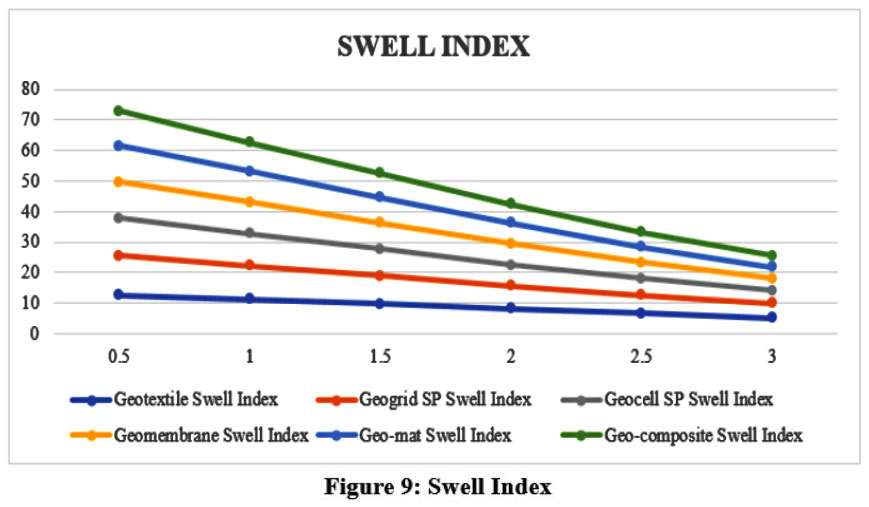 | Figure 9: Swell Index
|
From Figure 9, the Swell Index data for black cotton soil treated with different geo-synthetics across varying percentages (0.5% to 3.0%) illustrate a progressive and effective reduction in soil swell potential as the geo-synthetic content increases. This trend is crucial for mitigating volumetric changes in expansive soils, such as black cotton soil, which are prone to damaging structures due to excessive swelling and shrinkage. At a 0.5% inclusion rate, the swell index values are relatively high for all materials, with Geogrid (12.84) and Geotextile (12.65) exhibiting the highest swell indices, indicating minimal impact at lower doses. In contrast, Geo-composite already starts lower at 11.4, suggesting better early effectiveness. As the inclusion increases, there is a steady decline in swell index values across all geosynthetic types. At 1.5%, the difference becomes more prominent: Geo-composite (7.8), Geomembrane (8.52), and Geo-mat (8.4) show significantly better swelling control than Geotextile or Geogrid. By 3.0%, all materials demonstrate excellent suppression of swell behaviour. Geo-composite again leads with the lowest swell index of 3.72, followed closely by Geomembrane (3.96) and Geo-mat (3.84). These values represent a reduction of more than 65% compared to their initial swell indices at a 0.5% inclusion rate.
This analysis underscores the effectiveness of geosynthetics in controlling the swell potential of black cotton soil. Geo-composite, owing to its integrated structural and barrier properties, is the most efficient at minimizing swelling, making it particularly suitable for foundations, pavements, and subgrades in problematic soil conditions. Geomembrane and Geo-mat also offer strong performance, suggesting their suitability in projects requiring both durability and swelling resistance.
Cohesion and Friction Angle (°)
Cohesion
The data on cohesion in kilopascals (kPa) for black cotton soil stabilized with different types of geosynthetics across varying inclusion percentages (0.5% to 3.0%) demonstrates a clear and consistent increase in cohesion pressure as the percentage of geosynthetic material increases.50 Table 9 represents the cohesion pressure value of the geosynthetic
Table 9: Cohesion pressure value of geosynthetic
Percentage of Geo-synthesis (%) | Geotextile Cohesion (kPa) | Geogrid SP Cohesion (kPa) | Geocell SP Cohesion (kPa) | Geomembrane Cohesion (kPa) | Geo-mat Cohesion (kPa) | Geo-composite Cohesion (kPa) |
0.5 | 27.1 | 28 | 27.5 | 27.8 | 28 | 28.5 |
1.0 | 30.4 | 31.2 | 30.8 | 31 | 31.5 | 31 |
1.5 | 33.9 | 33.5 | 33.2 | 33.5 | 34 | 33 |
2.0 | 37.9 | 36 | 35.5 | 35.2 | 36 | 35 |
2.5 | 39.1 | 38.5 | 37.8 | 37.5 | 38.5 | 37 |
3.0 | 43.6 | 41 | 40 | 39.5 | 40 | 39 |
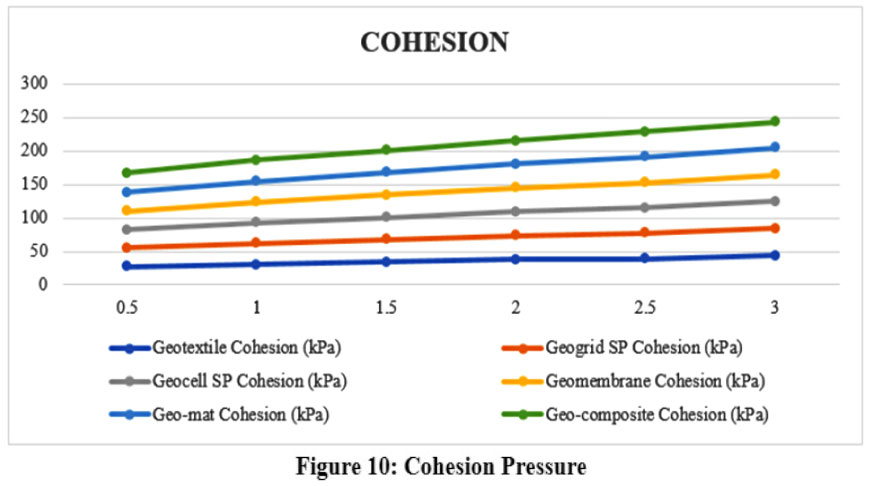 | Figure 10: Cohesion Pressure
|
From Figure 10, the cohesion values (in kPa) of black cotton soil reinforced with varying types of geo-synthetics at growing inclusion rates (ranging from 0.5% to 3.0%) show a consistent improvement in the soil’s shear strength characteristics. Cohesion, a fundamental parameter in soil mechanics, reflects the ability of soil particles to adhere to one another, and increasing it enhances stability and bearing capacity. At the initial level of 0.5%, the cohesion values are relatively close across all geosynthetics, with Geo-composite (28.5 kPa) showing the highest value, followed by Geo-mat and Geogrid (28 kPa each). As the geo-synthetic content increases, so does cohesion. By 1.5%, all geo-synthetics cross the 33 kPa mark, with Geo-mat (34 kPa) leading slightly. At 2.0%, the trend remains consistent: Geotextile (37.9 kPa) slightly surpasses the rest, followed by Geogrid (36 kPa) and Geo-mat (36 kPa). At the highest inclusion level of 3.0%, Geotextile yields a maximum cohesion value of 43.6 kPa, indicating its significant contribution to the internal bonding of the soil matrix. Geogrid (41 kPa) and Geo-mat (40 kPa) also show solid performance. Although Geo-composite has slightly lower cohesion at this level (39 kPa), its overall performance across all geotechnical properties (CBR, UCS, SP, Swell Index) still positions it as a leading stabilizing material. This cohesive strength enhancement shows that geosynthetics not only improve deformation and strength parameters but also significantly reinforce soil structure by increasing its resistance to shearing. Geotextile, in particular, stands out for its ability to boost cohesion, making it highly suitable for slope stability and earth retention applications. At the same time, Geo-composite continues to provide a well-balanced performance across all soil improvement metrics.
Friction Angle (°)
Table 10: Friction Angle value of geosynthetic
Percentage of Geo-synthesis (%) | Geotextile Friction Angle (°) | Geogrid SP Friction Angle (°) | Geocell SP Friction Angle (°) | Geomembrane Friction Angle (°) | Geo-mat Friction Angle (°) | Geo-composite Friction Angle (°) |
0.5 | 18.97 | 19.1 | 19.4 | 19.3 | 19.2 | 19.1 |
1.0 | 19.38 | 20 | 19.8 | 19.6 | 19.6 | 19.5 |
1.5 | 20.42 | 21 | 20.4 | 20.2 | 20 | 19.9 |
2.0 | 21.28 | 22.1 | 21.1 | 20.9 | 20.7 | 20.5 |
2.5 | 22 | 22.9 | 21.8 | 21.5 | 21.3 | 21.2 |
3.0 | 22.76 | 23.5 | 22.5 | 22.1 | 22 | 21.9 |
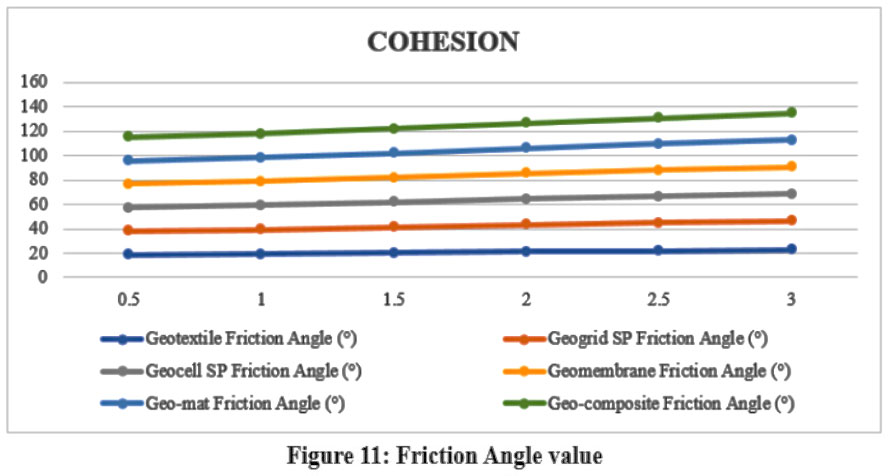 | Figure 11: Friction Angle value
|
From Figure 11, the friction angle (°) data for Stabilized black cotton soil with various geo-synthetics across inclusion levels from 0.5% to 3.0% reveal a steady enhancement in the shear resistance of the soil due to enhanced inter-particle friction. The angle of internal friction is a critical indicator of soil stability, especially for slope protection, embankments, and retaining structures. At a 0.5% inclusion rate, the friction angles are relatively modest, ranging from 18.97° (Geotextile) to 19.4° (Geocell). These values begin to improve noticeably as the geosynthetic content increases. At 1.5%, Geogrid (21°) and Geocell (20.4°) outperform others, indicating their grid and cell structures effectively mobilize shear resistance within the soil matrix.
At 2.0% and above, the increase becomes more pronounced. Geogrid consistently shows the highest friction angles, reaching 23.5° at 3.0%, making it particularly effective in enhancing soil strength through mechanical interlock and resistance to lateral movement. Geotextile (22.76°) and Geocell (22.5°) also perform well, closely followed by Geomembrane (22.1°) and Geo-mat (22°). Geo-composite, although slightly lower at 21.9°, still contributes significantly to shear strength. In general, this study has demonstrated that increasing the amount of geosynthetics used leads to an increase in soil frictional resistance. As the geogrid has a planar or open structure and strong tension resistance, the most significant enhancement in the friction angle can be imparted by it. It is, therefore, suitable for scenarios requiring load distribution and slope reinforcement. Geotextiles and Geocells provide practical friction enhancement actions to enhance bearing capacity and reduce deformation of subgrades and foundations.
Scanning Electron Microscopy (Sem) and X-Ray Diffraction (Xrd)
The objective here is to study the impact of these reinforcements on soil fabric, particle interactions, and crystalline structures, to assess the improvements brought about in the stability, strength, and durability of expansive soils for geotechnical applications. Further X-ray Diffraction (XRD) analysis was conducted to identify changes in crystalline composition and mineralogical phases, with a focus on variations in the presence and intensity of montmorillonite, kaolinite, and quartz. Comparison of results from untreated and treated soils provides insight regarding the possible performance enhancement caused by each type of reinforcement. This combined approach aligns with the overarching goal of assessing the ability of geo-synthetics to ameliorate the mechanical and structural properties of expansive soils for geotechnical engineering applications.
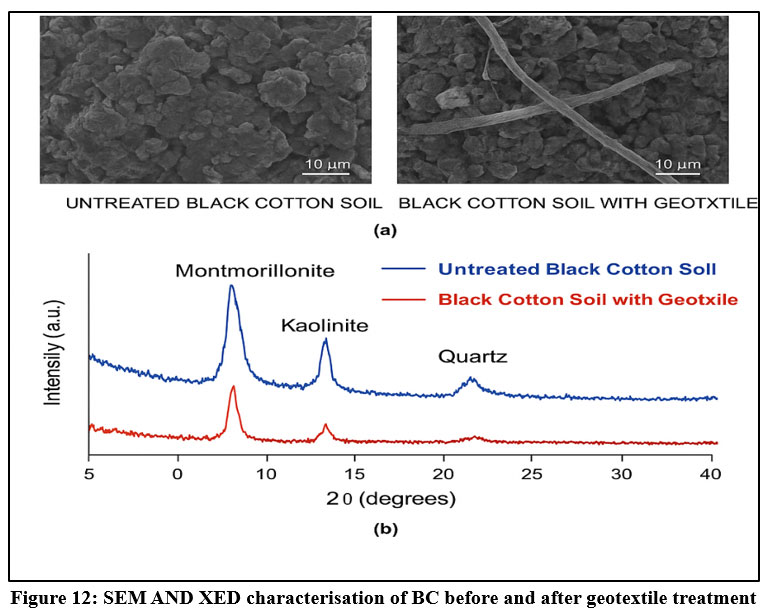 | Figure 12: SEM AND XED characterisation of BC before and after geotextile treatment
|
Figure 12 displays the differences in microstructure and mineralogy between untreated black cotton soil and geotextile-reinforced black cotton soil, providing insight into the effects of geotextiles in geotechnical engineering. Part (a) shows SEM images depicting that the untreated soil is highly porous with an aggregated structure and loosely bound particles. After reinforcement with geotextile, the fabric fibers are interwoven with the soil particles, resulting in a matrix that binds and confines the soil mass, thereby increasing its cohesion capacity and reducing its deformation potential.
In part (b), the X-ray diffraction (XRD) patterns show that the untreated soil exhibits firm peaks for montmorillonite, kaolinite, and quartz, indicative of a high clay content and expansive property typical of black cotton soils. When geotextile is incorporated, the intensities of these peaks are notably reduced. This suggests reduced crystalline activity due to improved compaction and encapsulation by the geotextile, leading to a more stable soil matrix. From a geotechnical perspective, the incorporation of geotextile significantly improves the engineering performance of expansive soils by providing filtration, separation, and reinforcement functions. It helps control differential settlement, increases tensile strength, reduces swelling and shrinkage tendencies, and enhances long-term durability. This makes geotextile-reinforced black cotton soil more suitable for use in foundations, embankments, retaining structures, and pavement subgrades.
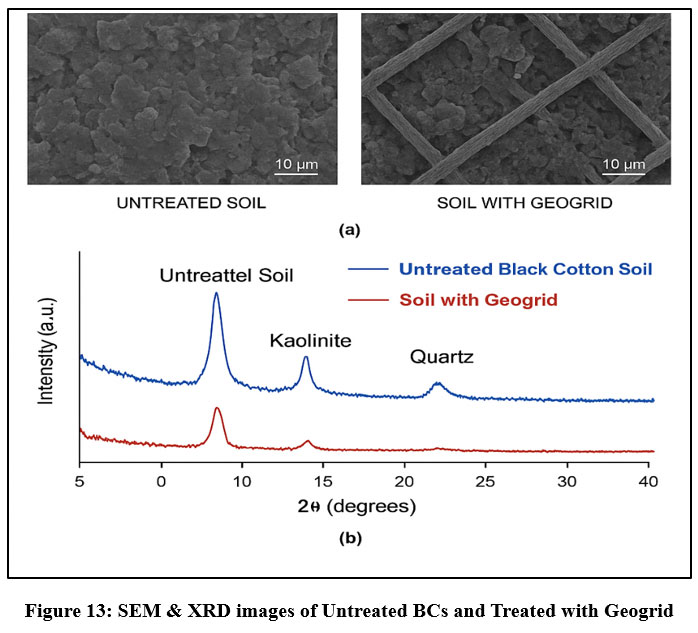 | Figure 13: SEM and XRD images of Untreated BCs and Treated with Geogrid
|
Figure 13 illustrates the microstructural and mineralogical changes in black cotton soil before and after reinforcement with a geogrid, highlighting its impact in geotechnical engineering applications.
In part (a), SEM images show the untreated black cotton soil possessing a loosely packed and irregularly arranged particle structure. In contrast, the soil reinforced with geogrid reveals an integrated, grid-confined matrix where the fibres of the geogrid intersect and encapsulate the soil particles, promoting mechanical interlock and structural stability. Part (b) presents X-ray diffraction (XRD) patterns, indicating a clear difference in mineralogical intensity. The untreated soil exhibits sharp peaks for kaolinite and quartz, confirming the expansive nature of black cotton soil, which is rich in clay minerals responsible for volumetric instability. After reinforcement with the geogrid, the intensity of these peaks diminishes, suggesting improved densification and decreased mineral exposure due to better compaction and matrix bonding.
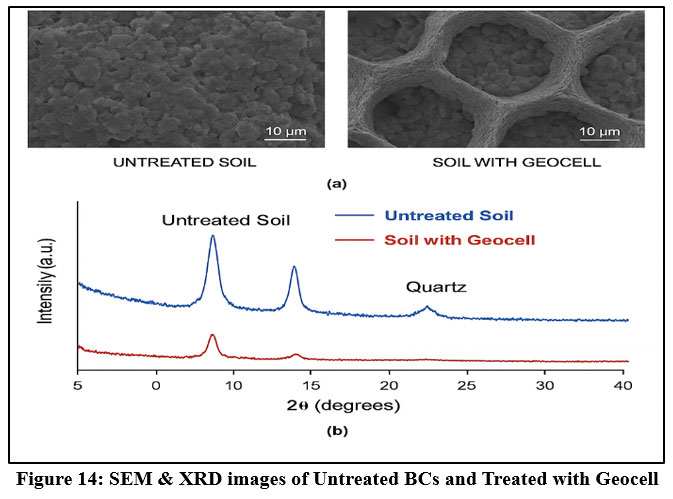 | Figure 14: SEM & XRD images of Untreated BCs and Treated with Geocell
|
Figure 14 presents a detailed comparison between untreated soil and soil treated with a geomembrane, highlighting key microstructural and mineralogical differences relevant to geotechnical engineering applications. In section (a), the SEM images depict the untreated soil as having an irregular, porous texture, indicative of high moisture susceptibility and low structural cohesion. In contrast, the soil with the geomembrane exhibits a distinct interface, where the geomembrane forms a continuous, impermeable barrier over the soil surface. This interface acts as a moisture seal and mechanical barrier, effectively reducing water infiltration and limiting soil particle movement, which is essential for applications such as landfill liners, containment systems, and slope protection.
Section (b) displays XRD patterns for both samples. The untreated soil exhibits sharp peaks for minerals such as Montmorillonite, Kaolinite, and Quartz, indicating the presence of expansive clay minerals that can lead to undesirable volume changes under varying moisture conditions. The treated soil, on the other hand, shows diminished peak intensities, particularly for Montmorillonite, suggesting a decrease in the activity of swelling minerals. This reduction in mineral reactivity reflects the geomembrane’s effectiveness in isolating the soil from moisture fluctuations, which helps maintain its volume stability and structural integrity.
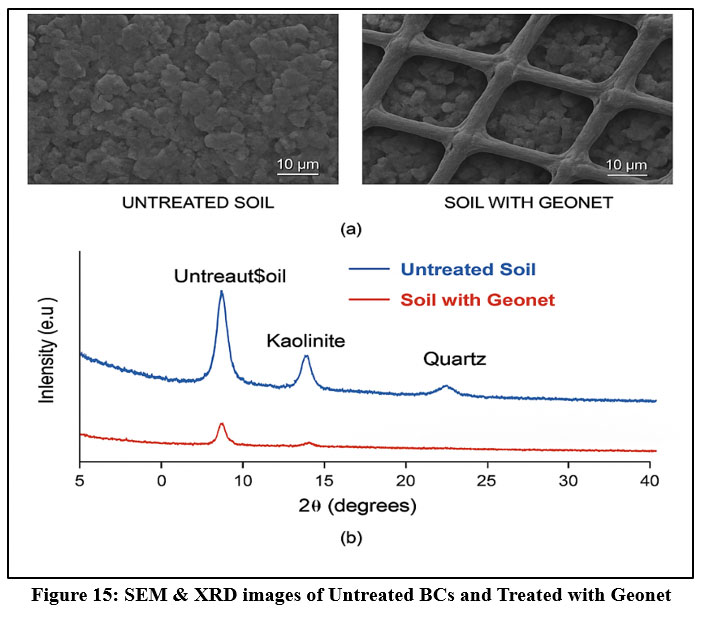 | Figure 15: SEM & XRD images of Untreated BCs and Treated with Geonet
|
Figure 15 provides a comparative analysis of untreated soil and soil reinforced with a geonet, focusing on microstructural and mineralogical aspects relevant to geotechnical engineering. In part (a), the SEM images show a clear distinction in structure: the untreated soil has a densely packed, unstructured arrangement with visible agglomeration of particles. In contrast, the soil with geonet exhibits a more open and interconnected structure. The geonet’s mesh-like configuration enables better distribution and confinement of soil particles, which enhances shear strength, drainage, and load-bearing capacity—critical factors in applications such as retaining walls, landfill liners, and sub-base reinforcement.
In part (b), the X-ray diffraction (XRD) patterns highlight changes in mineralogical composition. The untreated soil exhibits sharp peaks, particularly for Kaolinite and Quartz, indicating a high degree of crystallinity and potential for volumetric changes under varying moisture conditions. In contrast, the soil reinforced with geonet displays significantly reduced peak intensities, indicating a reduction in the activity of expansive minerals and improved dimensional stability. These changes suggest that the geonet not only serves as a structural reinforcement but also contributes to reducing shrink-swell behaviours and enhancing durability.
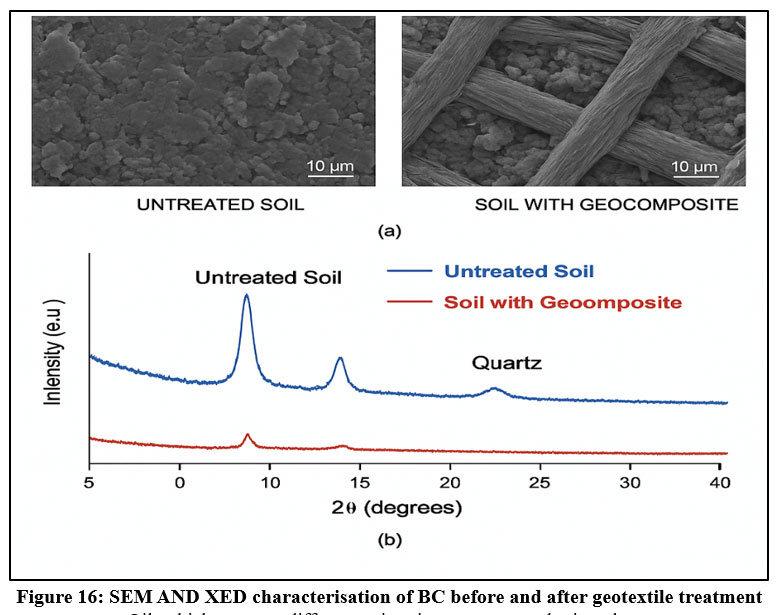 | Figure 16: SEM and XED characterisation of BC before and after geotextile treatment
|
Oil, which presents differences in microstructure and mineralogy.
Part (a) shows SEM images at a 10-µm scale. Untreated-soil SEM uses an irregular arrangement of soil particles that are compacted together, with no built-in structures for reinforcement. The soil with geo-composite, on the other hand, portrays soil particles placed in a fibrous, interwoven matrix typical of synthetic geo-composite materials. This structure significantly enhances mechanical interlocking and bonding between soil particles and geocomposite fibers, thereby improving the structural stability and load-bearing capacity of the soil.
Part (b) illustrates XRD patterns showing the mineralogical comparison for each sample. Peaks with different amplitudes can be observed in the untreated soil for minerals such as Montmorillonite, Kaolinite, and Quartz, indicating a high degree of crystallinity and the presence of an expansive clay mineral. Conversely, the intensity of the peaks in the geo-composite soil is reduced, indicating some alteration in the crystalline structure as a result of interaction with the synthetic fibers, which helps reduce their swelling potential and increase durability.
Therefore, the image consolidates the proof on querying how geo-composites transform the microstructural and mineral behaviour of soils into enhanced geotechnical applications. Figure 17 presents a closer view of the differences between untreated soil and soils treated with a geomembrane, highlighting the microstructural features of geotextiles, Geogrids, Geocells, Geomembranes, Geomats, and Geocomposites. Section (a) of the SEM micrographs shows the untreated soil having a texture that seems somewhat irregular and with pores, probably signifying a high level of moisture susceptibility with very low structural cohesion. On the other hand, soil with geomembrane formation exhibits a more straightforward interface of presence, where the geomembrane serves as a continuous and impermeable barrier over the soil surface. The interface functions as both a moisture seal and a mechanical barrier, thereby preventing water from penetrating the soil and restricting the movement of soil particles, which is crucial for applications such as landfill liners, containment, and slope protection.
Section (b) displays XRD patterns for both samples. “The unprocessed soil shows sharp crests for minerals like Montmorillonite, Quartz and Kaolinite indicating the presence of expansive clay minerals that can lead to undesirable volume changes under varying moisture conditions”. The treated soil, on the other hand, shows diminished peak intensities, particularly for Montmorillonite, suggesting a decrease in the activity of swelling minerals. This reduction in mineral reactivity reflects the geomembrane’s effectiveness in isolating the soil from moisture fluctuations, which helps maintain its volume stability and structural integrity.
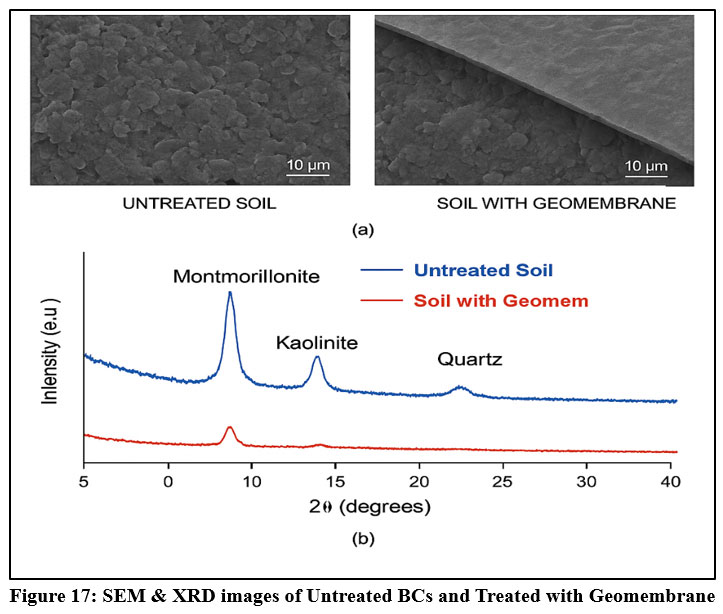 | Figure 17: SEM & XRD images of Untreated BCs and Treated with Geomembrane
|
Discussion
The experimental results show that adding geo-synthetics—such as Geotextile, Geo-grid, Geo-cell, Geo-membrane, Geo-mat, and Geo-composite—significantly improves the geo-technical characteristics of expansive black cotton soil. These results agree with earlier studies, which confirm the role of geo-synthetics in enhancing soil stability, managing volume changes, and increasing strength.
The observed rise in Unconfined Compressive Strength (UCS) and California Bearing Ratio (CBR) with more geosynthetic content aligns with research like Rao and Reddy, showing notable increases in CBR values for black cotton soil reinforced with geotextiles and geogrids. The reinforcement—mainly through lateral restraint and load sharing—explains the rise in UCS, supporting findings by Basha et al. (2005), which show that the tensile resistance provided by geosynthetics reduces axial deformation and improves load capacity.51
The reduction in Swelling Pressure and Swell Index with geosynthetic addition—especially in Geocomposite and Geomembrane treatments—is backed by earlier evidence. For example, Al-Kiki et al. noted that geomembranes act as impermeable barriers, decreasing water ingress and limiting volumetric expansion in expansive clays. Similarly, Kumar and Sharma observed that geocomposites significantly reduced swell potential due to their dual role as both reinforcements and barriers.52
The steady decline in the Plasticity Index (PI) with increased use of geosynthetics, especially with Geogrid, signals changes in soil structure and behavior. This matches observations by Ghosh and Subba Rao,who found that soils treated with reinforcement exhibited lower plasticity and improved workability due to decreased fine particle activity and enhanced moisture retention. The gains in cohesion and friction angle also reflect a more effective interaction between the soil and reinforcement.53
Geotextiles enhanced cohesion thanks to stronger bonding with soil particles, as noted in studies by Murthy et al., while Geogrid showed the most significant improvement in friction angle through mechanical interlock, confirming Zornberg and Gupta's findings on the importance of interlocking in reinforced soils.54
SEM analysis confirmed structural changes at the micro level. Treated soils exhibited denser matrices, fewer voids, and improved interlocking, similar to the findings reported by Karunarathna and Gunaratne regarding microstructural changes in geosynthetic-reinforced clayey soils.55
XRD patterns displayed lower intensity of expansive clay minerals like montmorillonite and kaolinite, supporting Sharma and Sivapullaiah’s results that chemical and mechanical treatments decreased the crystalline structure of expansive soils.56
Among all the reinforcements tested, Geo-composites, Geomembranes, and Geogrids consistently performed better in most parameters. This aligns with research, such as Muntohar et al., which highlights the versatile roles of geocomposites in drainage, reinforcement, and moisture control, making them ideal for expansive soils.57
Conclusion
The present study conclusively demonstrates the effectiveness of various geo-synthetics, namely geotextiles, Geogrids, Geo-cells, Geo-membranes, Geo-mats, and Geo-composites, in improving the geotechnical properties of black cotton soil. Across all parameters tested, geo-synthetics provided significant enhancements. “The specific gravity of unprocessed soil was 2.22, consistent with fine-grained soils”. “The Plasticity Index (PI) of untreated soil was 53.40%, which decreased substantially with the inclusion of geo-synthetics; the lowest PI value of 17% was observed with Geogrid at 3.0% inclusion. “The Standard Proctor Test” revealed that Geotextile offered the highest “Maximum Dry Density (MDD) of 23.3 g/cc at 1.552% Optimum Moisture Content (OMC)”, indicating excellent compaction characteristics. “California Bearing Ratio (CBR) values also improved significantly”, with Geo-composite and Geomembrane achieving the highest CBR value of 11.8% at 3.0% inclusion, compared to the untreated soaked CBR of just 5.98%. Similarly, Unconfined Compressive Strength (UCS) showed a marked improvement, with Geo-composite and Geomembrane reaching 171 kPa at a 3.0% inclusion, a substantial rise from the untreated condition. Swelling behaviour, a critical concern for expansive soils, was notably mitigated. Swelling Pressure reduced from above 10 kPa to just 3.1 kPa with Geo-composite, and the Swell Index decreased to 3.72 from initial values above 12, confirming enhanced dimensional stability. In terms of shear strength, Cohesion improved remarkably; the geotextile recorded the highest value of 43.6 kPa at a 3.0% inclusion. The Friction Angle also increased significantly, with Geo-grid leading at 23.5°, highlighting its superior resistance to shear deformation. In summary, the data clearly show that geo-synthetics substantially enhance the mechanical and physical properties of black cotton soil. Geo-composite emerged as the most effective across most tests, followed closely by Geo-membrane and Geo-grid. These materials are therefore recommended for field applications to stabilize expansive soils and improve the longevity and performance of civil infrastructure. SEM and XRD analysis conclude that geo-synthetic reinforcements significantly enhance the structural integrity and mineral stability of expansive black cotton soil. SEM images confirmed improved particle bonding and matrix formation, while XRD analysis revealed a reduction in the activity of expansive clay minerals. These improvements contribute to greater strength, reduced moisture susceptibility, and enhanced long-term performance, making reinforced soils more reliable for various geotechnical engineering applications. Geo-synthetic reinforcement significantly improves the stability and reductions of the swelling properties of black cotton soil, according to this study. Geo-composite, Geo-membrane, and Geo-grid emerged as the most efficient across most parameters. The use of these materials in infrastructure over expansive soils, such as black cotton soil, can drastically reduce maintenance and improve longevity and stability.
Acknowledgement
The author, Renu Tiwari, wishes to sincerely thank the Department of Civil Engineering at Dr. C.V. Raman University for providing the essential facilities and support necessary to conduct this research. Special recognition goes to Dr. Manoj Kumar Tiwari for his invaluable guidance, insightful suggestions, and continuous encouragement, all of which greatly contributed to the successful completion of this study. We also appreciate the laboratory staff and technical team for their assistance during the experimental phase. Additionally, we acknowledge the support of any funding agency or grant, if applicable, which helped facilitate this research. Lastly, the authors thank all individuals who directly or indirectly contributed to this work, whose cooperation and understanding made this possible.
Funding Sources
The author(s) received no financial support for the research, authorship, and/or publication of this article.
Conflict of Interest
The authors do not have any conflict of interest.
Data Availability Statement
The data that support the findings of this study are available from the corresponding author upon reasonable request
Ethics Statement
This research did not involve human participants, animal subjects, or any material that requires ethical approval.
Informed Consent Statement
This study did not involve human participants, and therefore, informed consent was not required.
Permission to Reproduce Material from Other Sources
Not Applicable.
Author Contributions
Renu Tiwari: Conceptualization, Methodology, Writing – Original Draft, Data Collection, Analysis, Writing – Review & Editing.
M. K. Tiwari: Visualization, Supervision, Project Administration.
References
- Ahmad S, Ghazi MSA, Syed M, Al-Osta MA. Utilization of fly ash with and without secondary additives for stabilizing expansive soils: a review. Results Eng. 2024; 22:102079.), https://doi.org/10.1016/j.rineng.2024.102079. Elsevier B.V
CrossRef - Nawaz MN, Akhtar AY, Hassan W, Khan MHA, Nawaz MM. Artificial intelligence-based prediction models of bio-treated sand strength for sustainable and green infrastructure applications. Transp Geotech. 2024;46:101262. doi: 10.1016/j.trgeo.2024.101262
CrossRef - Jamaludin N, Yunus NZM, Jusoh SN, Pakir F, Mohammed AMA. Strength characteristics of marine clay mixed with coal ash and cement with microstructural verification. Mar Geopress Geotech. Published online 2023. doi:10.1080/1064119X.2023.2284260
CrossRef - Choobbasti AJ, Pichka H. Improvement of soft clay using installation of geosynthetic-encased stone columns: numerical study. Arab J Geosci. 2014;7(2):597-607. doi:10.1007/s12517-012-0735-y
CrossRef - Bi G, Yang S, Wu Y, Sun Y, Xu H, Zhu B, et al. A preliminary study of the application of the strain-self-sensing smart geogrid rib in expansive soils. Geotext Geomembr. 2023;51(1):275-281. doi:10.1016/j.geotexmem.2022.10.005
CrossRef - Malik P, Mishra SK. A comprehensive review of soil strength improvement using geosynthetics. Mater Today Proc. 2023.
CrossRef - Zhang W, Tang X, Sun X, Yang R, Tong G, Guo J. Analytical method for quantifying performance of wicking geosynthetic stabilized roadway. Geotext Geomembr. 2023;51(1):259-274. doi:10.1016/j.geotexmem.2022.09.005
CrossRef - Divya PV, Viswanadham BVS, Gourc JP. Hydraulic conductivity behaviour of soil blended with goopy inclusions. Geotext Geomembr. 2018;46(2):121-130. doi:10.1016/j.geotexmem.2017.10.008
CrossRef - Allen TM, Bathurst RJ, Holtz RD, Walters DL, Lee WF. A new working stress method for the prediction of reinforcement loads in geosynthetic walls. Can Geotech J. 2003;40(5):976-994.
CrossRef - Teixeira SHC, Bueno BS, Zornberg JG. Pullout resistance of individual longitudinal and transverse geogrid ribs. J Geotech Geoenviron Eng. 2007;133(1):37-50. doi:10.1061/(ASCE)1090-0241(2007)133:1(37)
CrossRef - McCartney JS, Kuhn JA, Zornberg JG. Geosynthetic drainage layers in contact with unsaturated soils. In: Proceedings of the 16th International Conference on Soil Mechanics and Geotechnical Engineering. 2005:2301-2306. doi:10.3233/978-1-61499-656-9-2301
CrossRef - Li C, Zornberg JG. Mobilization of reinforcement forces in fiber-reinforced soil. J Geotech Geoenviron Eng. 2013;139(1):107-115. doi:10.1061/(ASCE)GT.1943-5606.0000745
CrossRef - Freilich BJ, Li C, Zornberg JG. Adequate shear strength of fiber-reinforced clays. In: 9th Int Conf on Geosynthetics – Geosynthetics: Advanced Solutions for a Challenging World. May 23-27, 2010; Guarujá, Brazil.
- Zornberg JG. Functions and applications of geosynthetics in roadways. Procedia Eng. 2017;189:298-306. doi:10.1016/j.proeng.2017.05.048
CrossRef - Zornberg JG, Gupta R. Reinforcement of pavements over expansive clay subgrades. In: Proceedings of the 17th International Conference on Soil Mechanics and Geotechnical Engineering: The Academia and Practice of Geotechnical Engineering. Vol 1. 2009:765-768. doi:10.3233/978-1-60750-031-5-765
CrossRef - Liu CN, Zornberg JG, Chen TC, Ho YH, Lin BH. Behavior of geogrid-sand interface in direct shear mode. J Geotech Geoenviron Eng. 2009;135(12):1863-1871. doi:10.1061/(ASCE)GT.1943-5606.0000150
CrossRef - Zornberg JG, Gupta R. Geosynthetics in pavements: North American contributions. Theme Speaker Lecture. In: Proceedings of the 9th International Conference on Geosynthetics. May 23-27, 2010; Guarujá, Brazil.
- Harianto T. Performance of subbase layer with geogrid reinforcement and zeolite-waterglass stabilization. Civil Eng J (Iran). 2022;8(2):251-262. doi:10.28991/CEJ-2022-08-02-05
CrossRef - Lu L, Ma S, Wang Z, Zhang Y. Experimental study of the performance of geosynthetics-reinforced soil walls under differential settlements. Geotext Geomembr. 2021;49(1):97-108. doi:10.1016/j.geotexmem.2020.09.007
CrossRef - Mohammadi M, Habibagahi G, Hataf N. A bioinspired technique for improving the interaction between cohesive soil and geotextile reinforcements. Int J Geosynth Ground Eng. 2021. doi:10.1007/s40891-021-00272-z
CrossRef - Soni A, Varshney D. Enhancing the California Bearing Ratio (CBR) value of clayey-sand type of soil in Mathura region. IOP Conf Ser Mater Sci Eng. 2021;1116(1):012031. doi:10.1088/1757-899X/1116/1/012031
CrossRef - Dassanayake SM, Mousa A, Fowmes GJ, Susilawati S, Zamara K. Forecasting the moisture dynamics of a landfill capping system comprising different geosynthetics: a NARX neural network approach. Geotext Geomembr. 2023;51(1):282-292. doi:10.1016/j.geotexmem.2022.08.005
CrossRef - Alam J, Akhtar N, Gupta RD. The effect of randomly oriented geofibre and lime on the CBR value of Dadri flyash: an experimental study. ISH J Hydraul Eng. 2008;14(1):63-71. doi:10.1080/09715010.2008.10514893
CrossRef - Negi MS, Singh S. Improvement of subgrade characteristics with inclusion of geotextiles. In: Sustainable Civil Engineering Practices. Singapore: Springer; 2020:133-144. doi:10.1007/978-981-15-3677-9_14
- Tanass F, Nechifor M, Ignat ME, Teaca CA. Geotextiles—a versatile tool for environmentally sensitive applications in geotechnical engineering. Textiles. 2022;2(2):189-208. doi:10.3390/textiles2020011
CrossRef - Eskandarnia G, Soltani P. Effect of fabric structure on in-plane and through-plane hydraulic properties of nonwoven geotextiles. Geotext Geomembr. 2023;51(4):1-14. doi:10.1016/j.geotexmem.2023.02.001
CrossRef - Hung WY, Nomleni IA, Soegianto DP, Praptawati A. Centrifuge modeling of the effect of mechanical connection on the dynamic performance of narrow geosynthetic-reinforced soil walls. Geotext Geomembr. 2023;51(4):156-172.
CrossRef - Hassan W, Farooq K, Mujtaba H, et al. Experimental investigation of mechanical behavior of geosynthetics in different soil plasticity indexes. Transp Geotech. 2023. doi:10.1016/j.trgeo.2023.100935
CrossRef - Reddy CNVS. Effect of randomly oriented synthetic fibre on clay of high compressibility. Indian J Geosynth Ground Improv. 2018;7(1):1-6.
- Ramprasath B, Murugesan R, Banerjee A, Anand A, Shashank. A comparative study of sandwich and hybrid sandwich composites using jute and Kevlar fibers. IOP Conf Ser Mater Sci Eng. 2020;912(5):052031. doi:10.1088/1757-899X/912/5/052031
CrossRef - Karthik PR, Chamberlain KS. Strengthening of subgrade clayey soil in road construction using fly ash and coir geotextile. Int Conf Adv Civ Eng. 2021. doi:10.1088/1757-899X/1197/1/012042
CrossRef - Çiçek E, Buyukakin V. Investigation of different types of fibers for roads by CBR tests. Politeknik Derg. 2023;26(1):367-375. doi:10.2339/politeknik.953967
CrossRef - Hazirbaba K, Gullu H. Field and laboratory performance of a cold-region sand stabilized with goopier and synthetic fluid. Cold Reg Sci Technol. 2017;135:16-27. doi:10.1016/j.coldregions.2016.12.009
CrossRef - Hazirbaba K, Gullu H. California Bearing Ratio improvement and freeze-thaw performance of fine-grained soils treated with geofiber and synthetic fluid. Cold Reg Sci Technol. 2010;63(1-2):50-60. doi:10.1016/j.coldregions.2010.05.006
CrossRef - Mughieda O. CBR behavior of sandy soil reinforced by geofiber material. IOP Conf Ser Mater Sci Eng. 2020;910(1):012005. doi:10.1088/1757-899X/910/1/012005
CrossRef - Jiang Y, Han J, Parsons RL. Numerical evaluation of secondary reinforcement effect on geosynthetic-reinforced retaining walls. Geotext Geomembr. 2020;48(1):98-109. doi: 10.1016/j.geotexmem.2019.103508
CrossRef - Junqueira FF, Silva ARL, Palmeira EM. Performance of drainage systems incorporating geosynthetics and their effect on leachate properties. Geotext Geomembr. 2006;24(5):311-324. doi: 10.1016/j.geotexmem.2006.03.008
CrossRef - Mooshaee MR, Sabour MR, Kamza E. The swelling performance of raw and modified bentonite of geosynthetic clay liner as the leachate barrier exposed to the synthetic E-waste leachate. Heliyon. 2022. doi: 10.1016/j.heliyon.2022.e11937
CrossRef - Mehta KS, Gupta V, Tiwari R, et al. Analysis of engineering properties of black cotton soil & stabilization using lime. Int J Eng Res Appl. 2014;4(5):25-32.
- Kabubo CK. Suitability of using mixes of heated black cotton soil, molasses, and lime in stabilization of expansive clay soil [PhD thesis]. Nairobi, Kenya: JKUAT-COETEC; 2019.
- Kumar S, Singh SK. Subgrade soil stabilization using geosynthetics: a critical review. Mater Today Proc. 2023.
CrossRef - Kelechi UP, Okeke OC. Geotextile and geomembrane: properties, production and engineering applications. Int J Adv Acad Res. 2018;4(11).
- Bureau of Indian Standards. IS: 2720 (Part I)-1983. Indian Standard for Preparation of Dry Soil Samples for Various Tests. New Delhi: BIS; 1983.
- Bureau of Indian Standards. IS: 2720 (Part IV)-1985. Indian Standard for Grain Size Analysis. New Delhi: BIS; 1985.
- Bureau of Indian Standards. IS: 2720 (Part V)-1985. Indian Standard for Determination of Liquid Limit and Plastic Limit. New Delhi: BIS; 1985.
- Bureau of Indian Standards. IS: 2720 (Part IV)-1985. Indian Standard for Grain Size Analysis. New Delhi: BIS; 1985.
- Bureau of Indian Standards. IS: 2720 (Part VII)-1980. Indian Standard for Determination of Water Content–Dry Density Relationship Using Light Compaction. New Delhi: BIS; 1980.
- Bureau of Indian Standards. IS: 2720 (Part X)-1991. Indian Standard for Determination of Unconfined Compressive Strength. New Delhi: BIS; 1991.
- Bureau of Indian Standards. IS: 2720 (Part XX)-1992. Indian Standard for Determination of Linear Shrinkage. New Delhi: BIS; 1992.
- Bureau of Indian Standards. IS: 2720 (Part XVI)-1965. Indian Standard for Laboratory Determination of CBR. New Delhi: BIS; 1965.
- Rao BN, Reddy KR. Performance of geosynthetic-reinforced pavements over expansive soils. Geotext Geomembr. 2018;46(2):101-111. doi: 10.1016/j.geotexmem.2017.11.005
CrossRef - Al-Kiki M, Al-Busoda B, Al-Dulaimi M. Improving expansive soil characteristics using geomembrane. Int J Civ Eng Technol. 2016;7(5):15-24.
- Ghosh A, Subba Rao KS. Soil stabilization using fly ash and rice husk ash. Waste Manag. 2009;29(4):1138-1142. doi: 10.1016/j.wasman.2008.08.012
CrossRef - Murthy VNS, Rao GV, Balan K. Engineering behavior of geosynthetic reinforced soil. Indian Geotech J. 2012;42(3):145-155.
- Karunarathna N, Gunaratne M. Effects of geosynthetics on clayey soils based on SEM analysis. Soils Found. 2020;60(1):126-136. doi: 10.1016/j.sandf.2020.01.003
CrossRef - Sharma RS, Sivapullaiah PV. Mineralogical and microstructural alteration of black cotton soil with lime. Appl Clay Sci. 2016;132-133:349-358. doi:10.1016/j.clay.2016.07.008
CrossRef - Muntohar AS, Widianti A, Hartono E, Diana W. Engineering properties of silty soil stabilized with lime and rice husk ash and reinforced with waste plastic fiber. Int J GEOMATE. 2018;14(42):151-158. doi:10.21660/2018.42.7463