
The Environmental Journey and Bioremediation of Chemical Pesticides
Nidhiba Rayjada
 and Chitra Bhattacharya
*
and Chitra Bhattacharya
*
1
Department of Lifesciences,
Program- Microbiology,
Atmiya University, Rajkot,
Gujarat
India
http://dx.doi.org/10.12944/CWE.20.2.2
Copy the following to cite this article:
Rayjada N, Bhattacharya C. The Environmental Journey and Bioremediation of Chemical Pesticides. Curr World Environ 2025;20(2). DOI:http://dx.doi.org/10.12944/CWE.20.2.2
Copy the following to cite this URL:
Rayjada N, Bhattacharya C. The Environmental Journey and Bioremediation of Chemical Pesticides. Curr World Environ 2025;20(2).
Download article (pdf)
Citation Manager
Publish History

Introduction
The primary goal of Indian planning and policy remains agricultural growth. As agriculture has advanced, pesticides have emerged as a crucial instrument for protecting plants and increasing food output. Additionally, pesticides contribute significantly by preventing plants from several terrible diseases. However, a variety of health issues in humans are brought on by pesticide exposure in the workplace and the environment. Exposure to pesticides is increasingly associated with cancer, hormone disruption, immunological suppression, lowered IQ, and reproductive problems.1 Chemicalpesticides are utilized extensively in public health and agriculture around the world. The application of pesticides may have unintended consequences for both well-being and the atmosphere owing to their high biotic activity and, in certain situations, their environmental persistence. However, pesticides are important in rural health programs because they help manage noxious, biting, irritating, or polluting bugs and additional pests that infest people and animals. The indiscriminate use of pesticides in agricultural practices and public health naturally results in residues in food products and feed crops, meat and poultry, fish and aquaculture, and milk products. Fortunately, there are positive developments in the phase-out of the persistent and hazardous class of pesticides. New biodegradable compounds with low toxicity to mammals, short half-lives, and improved compatibility with non-target organisms are being created.1 Nanotechnology, especially size-dependent nanoparticles (NPs), has become useful for detecting and cleaning pollutants. Through adsorption or chemical modification, NPs can identify, break down, and eliminate contaminants. They can also aid in microbial remediation by producing enzymes or immobilizing microorganisms.2 Because of their improved surface area, transport capabilities, and sequestration qualities, nanomaterials are quicker and less expensive than traditional methods. Carbon nanotubes, nanofibers, and nanoscale zero-valent iron have recently been employed to treat a variety of pollutants. Bio-inspired approaches for nanoparticle synthesis are advantageous due to their non-toxic, biocompatible, and less expensive processes. One such technique is green metal oxide nanoparticle production using plant extracts. These plant extracts contain bioactive substances like phenols, ascorbic acid, flavonoids, polyphenols, citric acid, alkaloids, terpenes, and reductase, which stabilize and reduce metal ions, leading to the development of sustainable and environmentally friendly metal oxide nanoparticles. We aimed in this review to focus on the new Nano technological approaches to control the usage of chemical pesticides in agricultural practices.
Rise of Chemical Pesticides
In the 1600s, ants were managed with a concoction of honey and arsenic. Farmers in the USA started retaining compounds like sulphur, calcium arsenate, and nicotine sulphate for farming purposes in the late 1800s. Still, their attempts were ineffective due to the antiquated application techniques. The Colorado potato beetle outbreak in the United States was contained in 1867 using arsenic, an impure form of copper (History of Pesticide Use 1998). Around and after World War II, some efficient and reasonably priced pesticides were synthesized and produced, marking a significant advancement in pesticide production. Aldrin, Dichlorodiphenyltrichloroethane (DDT), Dieldrin, B-Benzene Hexachloride (BHC), 2,4-Dichlorophenoxyacetic acid (2,4-D), Chlordane, and Endrin were discovered during this time.3
Since civilization's dawn, humans have been striving to improve living conditions, particularly in addressing hunger and controlling pests. India faces the challenge of feeding over 1000 million people and a large cattle population. The Green Revolution of 1960 provided hope for self-sufficiency in food production and the emergence of the largest producer of essential commodities.4 Chemical pesticides have significantly increased agricultural yields by regulating pests and diseases, and controlling insect-borne diseases. Effective pest management is crucial for increasing world food production, as over 45-50% of yearly food production is lost due to pest invasions.5
Classification of Chemical Pesticides
Several groups of insecticides, herbicides, fungicides, rodenticides, wood preservatives, garden chemicals, and household disinfectants that are used to inhibit or preventpests are collectively referred to as pesticides. Yet the physical and chemical characteristics of these pesticides diverge from class to class. As a result, it makes sense to organize them according to their characteristics and do research on them. Synthetic pesticides are substances that are created by humans and are not found in nature. Depending on the demands, they are divided into several classes. The three widely used approaches to classifying pesticides include (i) classifying them according to their channel of entry, (ii) classifying them according to the pesticide's purpose and the organism it kills, and (iii) classifying them according to their chemical composition.6
Pesticides based on modes of entry
Systemic Pesticides
That are captured by floras and are transported through their tissues, across the whole parts of the plant, like stems, leaves, roots, and flowers. They are employed by the plant's vascular system and are disseminated internally throughout the body part.7 Systemic insecticides, such as imidacloprid and clothianidin, are absorbed by plants and protect against insects that feed on the plant's tissues. They have high penetration capability, allowing them to flow unidirectionally or multi-directionally to kill target organisms. However, systemic pesticides can be absorbed by non-target plants, potentially affecting beneficial insects or species.8
Non-systemic Pesticides
These are non-translocating pesticides that persist on the plant's surface and are not captured or disseminated within its tissues. They act by coming into contact with pests and denaturing the insects. They are suitable for immediate control or pest knockdown but may require reapplying for new growth or pest re-infestation.9
2.2Pesticides based on function
This system assigns special names to pesticides to reflect their effects and classifies them according to the target organism. According to their intended use, pesticides are also categorized into groups. For instance, growth regulators either promote or prevent the development of pests, defoliants cause plant leaves to fall, desiccants cause insects to dry out and die, repellents prevent pests, and attractants captivate and trap pests.10 Certain pesticides that are employed against many insect categories may belong to multiple pesticide classes. In a similar vein, several pesticides can be categorized into various pesticide classes and control a wide variety of insect classes. As apesticide, acaricide, or nematicide, aldicarb is widely used in the Florida citrus industry to control insects, nematodes, and mites, respectively. Another typical example of 2,4-Dis used as an herbicide to eradicate broad-leafed weeds. Since repellents and attractants are used to manage pests, they are classified as pesticides.11
Pesticides based on chemical configuration
Based on the chemical composition, pesticides are classified into four categories: organochlorines, organophosphates, carbamates, and synthetic pyrethroids. Organochlorines, characterized by the occurrence of chlorine atoms, can cause insect death. Organophosphates, derived from phosphoric acid, work by inhibiting cholinesterase, an essential enzyme in vertebrates and invertebrates leading toa permanent overlay of acetylcholine neurotransmitter across a synapse ultimately resulting into paralysis and death. Carbamates, similar to organophosphates, have a shorter environmental persistence and inhibit the target bugs by interfering the nerve signal transmission. Synthetic pyrethroids, made by duplicating natural pyrethrins, are non-persistent and breakdown in the presence of visible light. Neonicotinoids, glyphosate, and triazines are herbicides that target photosynthesis and impede plant growth. These pesticides are used in agriculture and are considered safe for food products.11
Consumption of chemical pesticides in India
In 2020, India used more than 61000 tonnes (t) of pesticides, according to FAO (2022). In contrast, in overall, Argentina, China, and Brazil used 377000 t, 273000 t, and 241000 t of pesticides, respectively. In India, comparatively few pesticides are used (FAO, 2022). In comparison to 1998(102,240 tonnes), India's overall pesticide production doubled between 2022 and 2023(258,130 tonnes). Of the 293 registered pesticides, 104 are now produced in India. India exported 33000 tonnes of agrochemicals in 2020. India has outlawed 46 chemicals and four pesticide formulations as of April 2022.13,14 Concurrently, according to Center for Pesticide Suicide Prevention, 2025, approximately 145 million cases of unintentional acute pesticide poisoning are reported leading to 10,000 unintentional deaths every year in India. India is one of the nations that uses the most pesticides worldwide. In 1948, DDT, an organochlorine, was the first pesticide manufactured in India. Since then, India's pesticide industry has grown to become a significant agrochemical sector. As of March 1, 2021, there are 738 formulations and 293 pesticides registered for usage in India.14
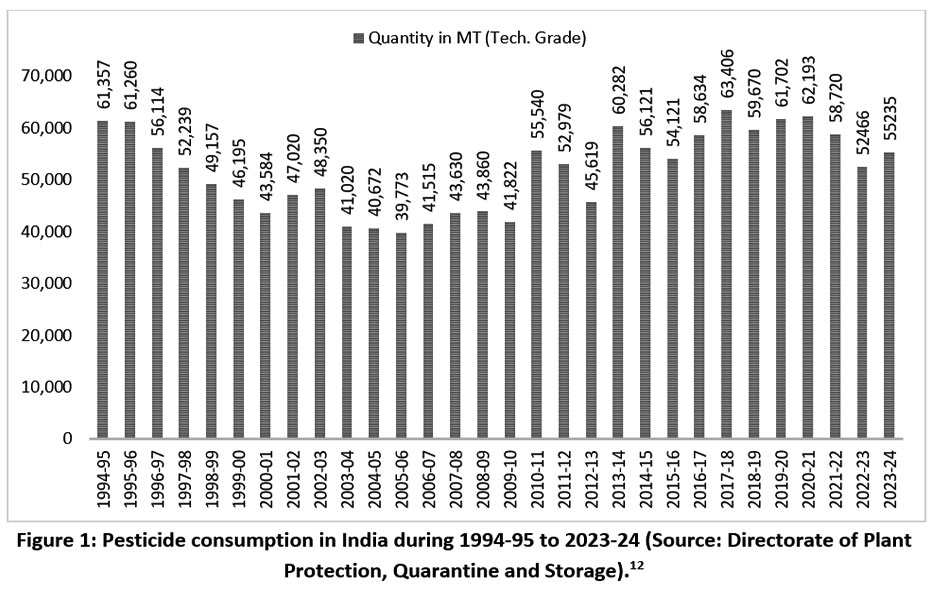 | Figure 1: Pesticide consumption in India during 1994-95 to 2023-24 (Source: Directorate of Plant Protection, Quarantine and Storage).12
|
The most widely used chemical pesticides and herbicides over five years, from 2019-20 to 2023-24 are depicted in Fig. 2. Chlorpyriphos, Fenvalerate, Fipronil, Malathion, Quinalphos, Carbendazim, Mancozeb, Sulphur, 2,4-D Amine salt, Glyphosate, and Pretilachlor are among the most used chemical pesticides in India out of 292 chemical pesticides including some miscellaneous pesticides. Sulphur showed the highest values across all years, peaking in 2021-22. Mancozeb also showed a notable increase in 2021-22. Chlorpyriphos, while showing some variation, generally decreased over the five years. The other chemicals, including Fenvalerate, Fipronil, Malathion, Quinalphos, Carbendazim, 2,4-D Amine salt, Glyphosate, and Pretilachlor, showed relatively low and stable values across the period, with some minor fluctuations between years. Overall, Sulphur and Mancozeb saw significant usage, especially in 2021-22, while the other chemicals were used in considerably smaller quantities.
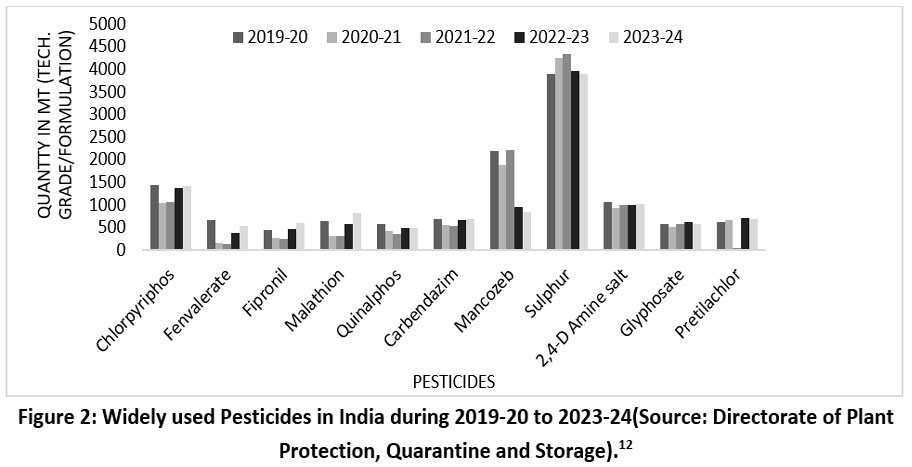 | Figure 2: Widely used Pesticides in India during 2019-20 to 2023-24(Source: Directorate of Plant Protection, Quarantine and Storage).12
|
All India Statistics of the area under cultivation and underuse of chemical pesticides during 2019-20 to 2023-24 are depicted in Fig. 3. In 2019-20, the cultivated area was 198,552 units, while the area using chemical pesticides was 108,035 units. In 2020-21, the cultivated area slightly decreased to 188,595 units, and the area using chemical pesticides increased to 111,289 units. In 2021-22, the cultivated area slightly increased to 195,875 units, while the area using chemical pesticides decreased to 96,042 units. In 2022-23, both areas saw increases, with the cultivated area reaching 209,936 units and the area using chemical pesticides reaching 118,110 units. Finally, in 2023-24, the cultivated area further increased to 213,445 units, and the area using chemical pesticides decreased slightly to 113,394 units. From the data, it is observed that almost half the area out of the total area under cultivation is still being cultivated with the use of chemical pesticides, and the remaining area is utilizing biopesticides or both (chemical + biopesticide). According to an article in Times of India approximately 115-120 million hectares’ soil degradation has occurred that increases the risks to food security and agricultural productivity. Hence, in the last five years, the area under consumption of chemical pesticides remain a matter of concern.
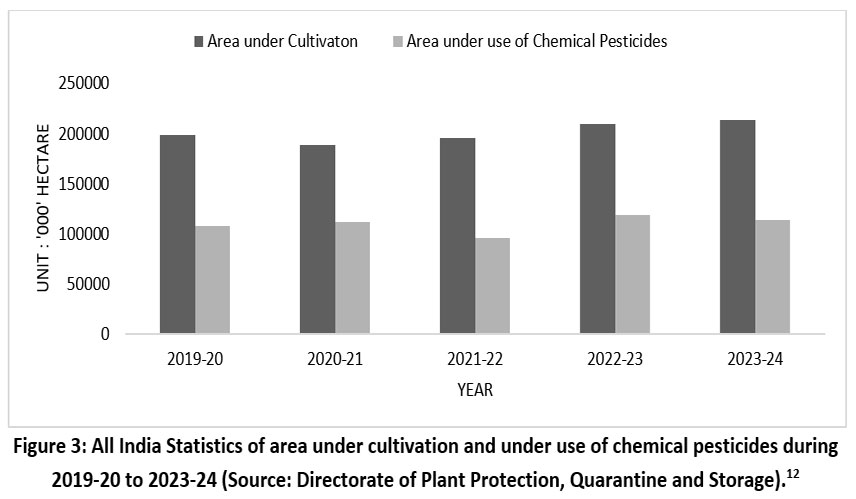 | Figure 3: All India Statistics of area under cultivation and under use of chemical pesticides during 2019-20 to 2023-24 (Source: Directorate of Plant Protection, Quarantine and Storage).12
|
Risks associated with pesticide usage
The dangers of consuming pesticides have outweighed the advantages. Pesticides impact aquatic and terrestrial food webs and bionetworks, as well as the biodiversity of plants and animals, and they have a severe impact on non-target species. About 80–90% of the pesticides that are administered have the potential to volatilize within a few days of application.15 It happens frequently and is likely to happen when utilizing sprayers. The pesticides that have been volatilized may affect organisms that are not their intended target organisms after evaporating into the atmosphere. An excellent illustration of this is the application of herbicides, which cause the treated plants to volatilize and release enough vapours to seriously harm other plants. Numerous marine and terrestrial animal and plant species have declined as a result of unregulated pesticide use. Additionally, they have put several endangered species—like the osprey, peregrine falcon, and bald eagle—in danger of going extinct. Furthermore, these chemicals have contaminated soil, water, and air to hazardous levels.
Pesticides, found in environmental media, can cause acute and chronic health problems in humans through inhalation, ingestion, and dermal contact. Chronic pesticide poisoning increases the incidence of cancer, chronic renal ailments, immune suppression barrenness, endocrine syndromes, neural disorders, and behavioural matters, especially among children. Moderate health threats include mild nuisances, flu, epidermal rashes, etc. Unprescribed pesticides in inappropriate doses disturb soil conditions and destroy beneficial microbes that are essential for agricultural practices.1Pesticides have caused serious problems, as seen in the 1984 Bhopal disaster, where thousands of animals and humans died due to a MIC gas leak.2However, sporadic use can lead to public health and food quality issues, resulting in ecological and health concerns. Unsuitable pesticide application pollutes the ecosystem, leading to residues in the food chain, increasing costs, and causing health hazards.1
Need for removal of pesticides
Mostly in farming, an estimated 1 to 2.5 million tons of dynamic chemical pesticide components are utilized every year. Numerous chemical pesticide classes with various applications and modes of application have been created and introduced to the marketplace since the 1940s, when certain synthetic organochlorine compounds were discovered to be insecticides. Pesticides share the trait of being widely administered across sizable regions in both urban and agricultural settings, although having distinct chemical assemblies and target species (for example, 40% are used as weed killers, followed by insecticides and fungicides). As a result, their use is a significant and challenging-to-control source of diffuse chemical pollution.17Theoretically, pesticides can only be approved for use if it can be shown that they do not persist in the environment for an extended time after their intended usage (soil half-lives of a few days to weeks). However, ng/liter to mg/liter amounts of pesticide residues are widely present in the natural environment. For example, investigations of raw drinking water and groundwater in developed nations usually reveal 10 to 20 chemicals in recurring results above 0.1 mg/liter, which is the maximum permitted concentration of pesticides in drinking water in many nations.13,14 The fact that roughly half of the compounds found had been phased out of usage and an additional 10 to 20% are steady revolution products is an even more startling sign of broad pesticide persistence. Groundwater is not the only source of pesticide pollution; transit from groundwater can result in a persistent, low-level presence of pesticides in surface waterways.16 Furthermore, high-altitude areas have discovered current-use pesticides, which have shown enough persistence to travel hundreds of kilometres in the atmosphere.17 Since degradation is the only process that truly removes pesticides from the environment, it is crucial to comprehend what governs the environmental fate of pesticides to protect human and natural food items like plants, marine biota, and drinking water.17
Since pesticide contamination is a concern, it is crucial to create technologies that ensure their safe, effective, and cost-effective removal to clean up a specific polluted site. The chemical should ideally be destroyed during treatment without producing any intermediates.18 In recent times, a variety of techniques have been established to neutralize pesticide residues, remediate polluted locations, and lessen the negative impacts of pesticides on the atmosphere and human health. Current technologies contain chemical treatments like progressive oxidation, which uses strong transient species, mainly the hydroxyl radical, and physical actions like adsorption and percolation filters. Heterogeneous photo catalysis with TiO2 is a widely used approach for investigation of pesticide breakdown.19 Pesticides can degrade or break down in soil, water, plants, and animals, or they can decompose when exposed to ultraviolet (UV) light. The most prevalent kind of degradation in soil is caused by the activities of microorganisms, particularly bacteria and fungi, while there are also purely chemical reactions that contribute to deterioration. The breakdown of pesticides by microbes is not a mystery. Simply said, microorganisms provide a medium and an energy source for rather basic chemical reactions. In exchange, they receive food, vital components, or energy to continue their daily activities.20
Bioremediation of Pesticides
Pesticides have undoubtedly had a significant negative influence on soil fertility. Pesticide-contaminated soils have garnered a lot of interest due to their effects on the atmosphere and human health. For the clean-up of pesticide-impacted soils, bioremediation holds enormous promise. Microorganisms that are present in the soil can eliminate chemicals from the environment. The utmost vital technique for removing contaminants from the atmosphere is biopesticide enzymatic degradation, and enzymatic processes have been revealed to have a great potential for bioremediation when it comes to breaking down persistent chemical compounds. Therefore, bioremediation is a promising strategy to combat insecticide pollution, which will certainly address the issue of soil pesticide adulteration. This technique has repeatedly demonstrated its ability to break down a variety of organic chemicals in addition to insecticides. Therefore, it is time to make use of this environmentally friendly technology for a safer and better future.21
Pesticides are utilized in the agriculture sector to defend against plant pathogens and insects. However, only a segment of these pesticides is used, leaving residues in cereal grains, vegetables, and fruits, potentially causing ecological contamination. Microbial degradation method is a more effective and affordable method for pesticide degradation as compared to traditional physical and chemical methods. Microorganisms, including bacteria, fungi, actinomycetes, and algae, can degrade residual pesticides using them as nutrients. Key responses in insecticide devastation include mineralization and co-metabolism.22 Factors influencing insecticide degradation include the type of pesticide, the type of microorganisms, temperature, humidity, and acidity in the atmosphere. Plasmid-based genes encode numerous enzymes that degrade pesticides. Genetically engineered rhizobacteria can enhance bioremediation of pollutants and pesticides, making them valuable for bioremediation of assorted pesticides from the ecosystem.22 Remediation strategies are typically classified as in-situ or ex-situ based on whether the polluted medium is removed or retained from its source.23 The treatment of quarried soil that is carried to a dealing plant is a defining feature of ex-situ bioremediation techniques, such as composting and the usage of bioreactors. The elimination and transportation of polluted soil are the remediation process's greatest drawbacks since they overburden the system and increase the risk of contaminant dispersion, even while the potential for improved control of the process is a benefit. In-situ, bioremediation is a non-invasive, environmentally benign method that encourages the contaminant to break down at the contaminated site while maintaining the ecosystem. Among these, biostimulation, bioaugmentation, and phytoremediation can be mentioned.24
To increase the native microbiota's ability for disintegration, bio stimulation involves changing elements that affect it, such as adding nutrients or electron acceptors.25 When the local microbiota is insufficient to break down or metabolize the pollutant compound, bioaugmentation is advised. It is based on inoculating the medium to be remediated with microbes, such as bacteria, or using consortia that have the desired catabolic roles for the degradation of the impure compounds.26 The process of using plants to remove, immobilize, or change contaminants is known as phytoremediation, and it can be further classified into many subcategories based on the mechanisms at play.27 Biological, chemical, and physical techniques are being employed to reduce the adverse effects of pesticides. Physico-chemical methods are more costly and occasionally demonstrate insufficient cleanup that results in equally or more hazardous products. Therefore, biological approaches are favored. Nanobiotechnology has emerged as a useful method for pesticide breakdown in recent years.28
The effectiveness of traditional bioremediation methods can be significantly increased by utilizing contemporary biotechnological tools like cell engineering and nanotechnology.29 A novel method for cleaning up harmful contaminants is called Nano-bioremediation, in which nanoparticles (NPs) are linked to microorganisms. To eliminate organic pollutants, nanoparticles can be used directly or through adsorption, where they work by promoting microbial development, the synthesis of biosurfactants, and enzymatic activity.30
Nanotechnology-based Bioremediation
Nano-biotechnology has significantly improved the remediation of pollutants in soil, water, and air, focusing on treatment, sensing, and prevention. It could be integrated with conventional bioremediation or used directly to degrade heavy metals, herbicides, pesticides, and insecticides, improving their reactivity for degradation and detoxification.31 Industrial growth and population growth have led to pollution, requiring nanotechnology for efficient and sustainable solutions. Nano remediation, using engineered nanomaterials in water, soil, and air, is crucial for environmental protection.32 Nanosized materials, due to their distinctive surface characteristics, demonstrate the capacity for remediation of various contaminants.33 Nanomaterials like metallic, magnetic, carbon, and zero-valent iron effectively remove contaminants, heavy metals, and pollutants, while polymer nanotechnology creates nanoparticles, nanocomposites, and nanofiltration membranes for the treatment of contaminated sites.34 Environmentally friendly processes for producing functional nanomaterials are a promising alternative to traditional nanoremediation methods. These materials, including metal oxide nanoparticles, are derived from green plants, bacteria, fungi, algae, and viruses.35 Microorganisms in nanotechnology make it more environmentally friendly. However, chemical nanoparticles may have drawbacks. Bioactive enzymes from bacteria, fungi, and plants can produce metallic nanoparticles and reductive agents, with improved firmness in aqueous environments.36
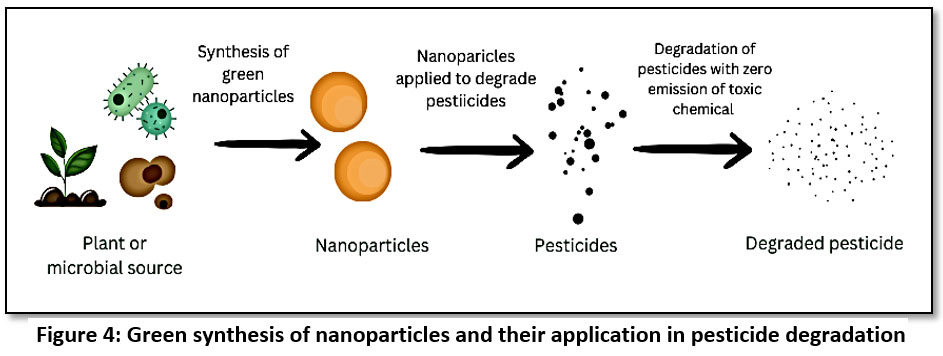 | Figure 4: Green synthesis of nanoparticles and their application in pesticide degradation
|
Plant-Extract Based Nanoparticles
The direct utilization of natural and biological resources through simpler, non-toxic, biocompatible, and less expensive synthesis processes makes bio-inspired approaches for nanoparticle synthesis advantageous. One straightforward, affordable, and environmentally beneficial technique among the bio-inspired approaches is the green production of metal oxide nanoparticles utilizing plant extracts.37 Bioactive substances like phenols, ascorbic acid, flavonoids, polyphenols, citric acid, alkaloids, terpenes, and reductase are found in plant extracts. These physiologically active substances function as stabilizing and reducing agents, aiding in the development of the intended nanoparticle shapes and the decrease of metal ion precursors. The potential for switching to sustainable and environmentally friendly sources is drawing interest in the synthesis of metal oxide nanoparticles.38
Immobilization of Nanoparticles
Various nanoparticles have been created employing biological entities since the fundamental concept of how nanoparticles interact with bacteria was introduced. The goal of "green nanotechnology" is now to immobilize microbial enzymes with nanoparticles for desired properties. Their application in environmental remediation blends the two technologies into a novel, hybrid strategy that may lead to new methods of sustainable pesticide mitigation. Here, several nanoscale structures work in tandem or sequentially with bacteria, enzymes, or biopolymers to improve the breakdown of pesticides from contaminated areas.39 Pesticides degraded using these bioagents by immobilizing nanoparticles are depicted in Table 1.
Table 1: Pesticide degradation by bioagents immobilized on nanoparticles
Species | Nanoparticle used | Pesticides degraded |
Microorganisms | ||
Escherichiacoli | Silanized Silica nanoparticle (SiNPs) | Atrazine40 |
Streptomyces sp. N01 | Fe3O4 nanoparticle | Quinoline41 |
Rhodococcusrhodochrous | Fe3O4 nanoparticle | Chlorophenols42 |
Bacillus badius, Bacillus ensimensis | a–Fe2O3 magnetic nanoparticle | Atrazine43 |
Enzymes | ||
Phosphohydrolase | Nanomagnets coated with lipids | Ethyl paraoxon44 |
Organophosphorus hydrolases from Flavobacterium sp. | Silica nanoparticles | Diethyl-4-nitrophenyl phosphate (paraoxon)45 |
Fungal laccase derived from Trametes versicolor | Silica nanoparticles | 2,4-Dinitrophenol (2,4-DNP)46 [used inmanufacturing pesticides] |
Biopolymers from Microbes | ||
Polymer extracted from Itajahiasp(Phylum-Basidiomycetes) | FeS nanoparticle | Lindane47 |
Cyclodextrin | Silica nanoparticle | DDE, DDT48 |
Chitosan | Silver nanoparticle Copper nanoparticle Gold nanoparticle | Atrazine49 Methyl parathionand parathion Methyl parathion50 |
Nano encapsulation
Nanotechnology increases phytoremediation's efficacy. Nanoscale zero-valent ions can remove organic pollutants such as molinate, atrazine, and chlorpyrifos. Nanoparticles can also be used in conjunction with phytoremediation in enzymatic bioremediation. Certain complex organic compounds, like organochlorines and long-chain hydrocarbons, are predominantlyresilient to microbial and plant catalysis. Linking nanotechnology and biotechnology could help get around this restriction. For instance, complex organic materials could be broken down into simpler chemicals by enzymes encapsulated in nanoparticles, which would then be quickly broken down by bacteria and plants working together.40
Discussion
This review article discussed the, chemical pesticides, which play a vital role for crop production, and have significant environmental repercussions. Their journey from application to ecological impact underlines the need for sustainable clean-up strategies. Bioremediation offers a promising, eco-friendly, and cost effective solution for pesticide detoxification. However, optimizing conditions and improving microbial efficiency remain key research priorities for broader field applications.
Conclusion
Researchers are interested in nanotechnology because of its huge surface area, versatility, stability under extreme conditions, ease of use and efficiency in material manipulation, enhanced interaction, and many more. By combining nanotechnology with microbes, enzymes, and plant extracts, pesticide pollution can now be managed in a more environmentally friendly manner. The utilization of microbes can diminish the risk linked with chemically produced nanoparticles. The remaining deposits are also easily unglued using basic filtration and precipitation procedures, or are biocompatible. The commercialization of these Nano technological features presents a larger obstacle. Currently, just 1% of these Nano technological features are available for purchase. Therefore, the large-scale implementation of these unpretentious and effective plant or microbial-assisted nanotechnology approaches will be an initial stage for industries.
Acknowledgement
The authors would like to thank the Department of Life Sciences, Program – Microbiology, Faculty of Science is highly appreciated for allowing the research work. The authors are thankful to the library learning facilities for the utilization of the library and internet facilities. The authors are also grateful to Atmiya University, Rajkot, Gujarat, for granting the Ph.D. research work.
Funding Sources
The author(s) received no financial support from any funding agencies for the research, authorship, and publication of this article.
Conflict of Interest
The authors do not have any conflict of interest.
Data Availability Statement
This statement does not apply to this article
Ethics Statement
This research did not involve human participants, animal subjects, or any material that requires ethical approval
Informed Consent Statement
This study did not involve human participants, and therefore, informed consent was not required.
Permission to reproduce material from other sources
Not Applicable
Author Contributions
Nidhiba Rayjada: Data Collection, Analysis, Drafting, Writing – Review & Editing.
Chitra Bhattacharya: Conceptualization, Visualization, Supervision, Project Administration.
References
- AbhilashP. C. & SinghN. Pesticide use and application: an Indian scenario. Journal of hazardous materials. 2009; 165(1-3): 1-12.https://doi.org/10.1016/j.jhazmat.2008.10.061
CrossRef - Benjamin S. R., Lima F. D., Florean E. O. P. T. & Guedes M. I. F. Current trends in nanotechnology for bioremediation. International Journal of Environment and Pollution. 2019; 66(1-3): 19-40.
CrossRef - Delaplane, K.S. Pesticide usage in the United States: history, benefits, risks, and trends. 2000; Cooperative Extension Service. The University of Georgia, College of Agricultural and Environmental Sciences. Bulletin 1121. Reprinted November, 2000. http://pubs.caes.uga.edu/ caespubs/pubs/PDF/B1121.pdf
- Gupta, P. K.Pesticide exposure—Indian scene. Toxicology. 2004; 198(1-3): 83-90. https://doi.org/10.1016/j.tox.2004.01.021
CrossRef - Agoramoorthy, G. (2008). Can India meet the increasing food demand by 2020?. Futures, 40(5), 503-506.https://doi.org/10.1016/j.futures.2007.10.008
CrossRef - Kaur, R., Mavi, G. K., Raghav, S., & Khan, I.Pesticides classification and its impact on environment. Int. J. Curr. Microbiol. Appl. Sci. 2019; 8(3): 1889-1897. https://doi.org/10.20546/ijcmas.2019.803.224
CrossRef - Cloyd, R. A., Bethke, J. A., & Cowles, R. S. Systemic insecticides and their use in ornamental plant systems. Floriculture and Ornamental Biotechnol. 2011; 5: 1-9.
- Simon-Delso, N., Amaral-Rogers, V., Belzunces, L.P. Systemic insecticides (neonicotinoids and fipronil): trends, uses, mode of action and metabolites. Environ Sci Pollut Res. 2015; 22: 5–34. https://doi.org/10.1007/s11356-014-3470-y
CrossRef - Wu, T., Zhao, K., Liu, S., Bao, Z., Zhang, C., Wu, Y. & Du, F. Promising nanocarriers endowing non-systemic pesticides with upward translocation ability and microbial community enrichment effects in soil. Chemical Engineering Journal. 2023; 474: 145570.https://doi.org/10.1016/j.cej.2023.145570
CrossRef - Ahmad, M. F., Ahmad, F. A., Alsayegh, A. A., Zeyaullah, M., AlShahrani, A. M., Muzammil, K.& Hussain, S. Pesticides impacts on human health and the environment with their mechanisms of action and possible countermeasures. Heliyon. 2024;10(7): e29128 DOI: 10.1016/j.heliyon.2024.e29128
CrossRef - Yadav, I. C., & Devi, N. L. Pesticides classification and its impact on human and environment. Environmental science and engineering. 2017; 6(7): 140-158.
- https://ppqs.gov.in/en/statistical-database/pesticidewise-demand-indigenous-pesticides-during-2016-17-2020-21
- Soman, S., Christiansen, A., Florinski, R., Bharat, G., Steindal, E. H., Nizzetto, L. & Chakraborty, P. An updated status of currently used pesticides in India: Human dietary exposure from an Indian food basket. Environmental Research. 2024; 242: 117543.https://doi.org/10.1016/j.envres.2023.117543
CrossRef - Pandey, J. K. (2023). Use of Hazardous Chemical Pesticides in India: A Review. Proceedings of the National Academy of Sciences, India Section B: Biological Sciences, 93(3), 523-537. https://doi.org/10.1007/s40011-022-01425-4
CrossRef - Majewski, M. S. Pesticides in the atmosphere: distribution, trends, and governing factors.2019; CRC press.https://doi.org/10.1201/9780429062780
CrossRef - Helfrich, L. A., Weigmann, D. L., Hipkins, P. A., & Stinson, E. R. Pesticides and aquatic animals: a guide to reducing impacts on aquatic systems.Virginia Tech. 2009; 1-25.
- Fenner, K., Canonica, S., Wackett, L. P., & Elsner, M. Evaluating pesticide degradation in the environment: blind spots and emerging opportunities. Science. 2013; 341(6147): 752-758.DOI: 10.1126/science.. 1236281
CrossRef - Frazar, C. The bioremediation and phytoremediation of pesticide-contaminated sites. Washington, DC: US Environmental Protection Agency.2000; p. 55.
- Parte, S. G., Mohekar, A. D., & Kharat, A. S. Microbial degradation of pesticide: a review. African journal of microbiology research. 2017; 11(24): 992-1012.https://doi.org/10.5897/AJMR2016.8402
CrossRef - Qiu, X., Zhong, Q., Li, M., Bai, W., & Li, B. (2007). Biodegradation of p-nitrophenol by methyl parathion-degrading Ochrobactrum sp. B2. International biodeterioration & biodegradation, 59(4), 297-301.https://doi.org/10.1016/j.ibiod.2006.09.005
CrossRef - Uqab, B., Mudasir, S., & Nazir, R. Review on bioremediation of pesticides. J Bioremed Biodegr. 2016;7(3): 343. DOI: 10.4172/2155-6199.1000343
CrossRef - Sehrawat, A., Phour, M., Kumar, R., & Sindhu, S. S. (2021). Bioremediation of pesticides: an eco-friendly approach for environment sustainability. Microbial Rejuvenation of Polluted Environment: Volume 1, 23-84. DOIhttps://doi.org/10.1007/978-981-15-7447-4_2
CrossRef - Amponsah, N. Y., Wang, J., & Zhao, L. A review of life cycle greenhouse gas (GHG) emissions of commonly used ex-situ soil treatment technologies. Journal of Cleaner Production. 2018; 186: 514-525.https://doi.org/10.1016/j.jclepro.2018.03.164
CrossRef - Gonçalves, C. R., & da Silva Delabona, P. Strategies for bioremediation of pesticides: challenges and perspectives of the Brazilian scenario for global application–a review. Environmental Advances. 2022; 8:100220.https://doi.org/10.1016/j.envadv.2022.100220
CrossRef - Tyagi, M., da Fonseca, M. M. R., & de Carvalho, C. C. Bioaugmentation and biostimulation strategies to improve the effectiveness of bioremediation processes. Biodegradation. 2011; 22: 231-241. https://doi.org/10.1007/s10532-010-9394-4
CrossRef - Cycon, M., Mrozik, A., & Piotrowska-Seget, Z. (2017). Bioaugmentation as a strategy for the remediation of pesticide-polluted soil: A review. Chemosphere, 172, 52-71. https://doi.org/10.1016/j.chemosphere.2016.12.129
CrossRef - Eevers, N., White, J. C., Vangronsveld, J., &Weyens, N. Bio-and phytoremediation of pesticide-contaminated environments: a review. Advances in botanical research. 2017; 83: 277-318. https://doi.org/10.1016/bs.abr.2017.01.001
CrossRef - Sunanda, Ghosh Sachan, S. Nanobioremediation of pesticides by immobilization technique: a review. Int. J. Environ. Sci. Technol. 2023; 20: 3455–3466. https://doi.org/10.1007/s13762-021-03759-4
CrossRef - Giri, B. S., Geed, S., Vikrant, K., Lee, S. S., Kim, K. H., Kailasa, S. K.& Singh, R. S. Progress in bioremediation of pesticide residues in the environment. Environmental Engineering Research. 2021; 26(6): 135-149https://doi.org/10.4491/eer.2020.446
CrossRef - Bhatt, P., Pandey, S. C., Joshi, S., Chaudhary, P., Pathak, V. M., Huang, Y.& Chen, S. Nanobioremediation: A sustainable approach for the removal of toxic pollutants from the environment. Journal of Hazardous Materials. 2022; 427: 128033.https://doi.org/10.1016/j.jhazmat.2021.128033
CrossRef - Tripathi, S., Sanjeevi, R., Anuradha, J., Chauhan, D. S. &Rathoure, A. K. Nano-bioremediation: nanotechnology and bioremediation. In Research anthology on emerging techniques in environmental remediation. 2022; 135-149.10.4018/978-1-6684-3714-8.ch007
CrossRef - Del Prado-Audelo, M. L., García Kerdan, I., Escutia-Guadarrama, L., Reyna-González, J. M., Magaña, J. J. & Leyva-Gomez, G. Nanoremediation: nanomaterials and nanotechnologies for environmental cleanup. Frontiers in Environmental Science. 2021; 9: 793765. https://doi.org/10.3389/fenvs.2021.793765
CrossRef - Kumar, L., Ragunathan, V., Chugh, M., & Bharadvaja, N. (2021). Nanomaterials for remediation of contaminants: a review. Environmental Chemistry Letters, 19(4), 3139-3163. https://doi.org/10.1007/s10311-021-01212-z
CrossRef - Stefaniuk, M., Oleszczuk, P., & Ok, Y. S. Review on nano zerovalent iron (nZVI): from synthesis to environmental applications. Chemical Engineering Journal. 2016;287: 618-632.https://doi.org/10.1016/j.cej.2015.11.046
CrossRef - Dejen, K.D., Sabir, F.K., Ananda Murthy, H.C., Ayanie, G.T., Shume, M.S., Bekele, E.T. Green Synthesis of Nanomaterials for Environmental Remediation. In: Policarpo Tonelli, F.M., Roy, A., Ananda Murthy, H.C. (eds) Green Nanoremediation. Springer, Cham. 2023; 27-65. https://doi.org/10.1007/978-3-031-30558-0_2
CrossRef - Mandeep, & Shukla, P. Microbial nanotechnology for bioremediation of industrial wastewater. Frontiers in Microbiology. 2020; 11: 590631.https://doi.org/10.3389/fmicb.2020.590631
CrossRef - Varghese, R. J., Zikalala, N., & Oluwafemi, O. S. Green synthesis protocol on metal oxide nanoparticles using plant extracts. In Colloidal metal oxide nanoparticles. Elsevier.2020; 67-82. https://doi.org/10.1016/B978-0-12-813357-6.00006-1
CrossRef - Iqbal, A., Haq, A. U., Cerrón-Calle, G. A., Naqvi, S. A. R., Westerhoff, P., & Garcia-Segura, S. Green synthesis of flower-shaped copper oxide and nickel oxide nanoparticles via Capparis decidua leaf extract for synergic adsorption-photocatalytic degradation of pesticides. Catalysts. 2021; 11(7): 806. https://doi.org/10.3390/catal11070806
CrossRef - Hidangmayum, A., Debnath, A., Guru, A., Singh, B. N., Upadhyay, S. K., & Dwivedi, P. Mechanistic and recent updates in nano-bioremediation for developing green technology to alleviate agricultural contaminants. International Journal of Environmental Science and Technology. 2023; 20(10): 11693-11718.
CrossRef - Reategui, E., Reynolds, E., Kasinkas, L., Aggarwal, A., Sadowsky, M.J., Aksan, A., Wackett, L.P. Silica gel-encapsulated AtzA biocatalyst for atrazine biodegradation. Appl MicrobiolBiotechnol.2012;96:231–240. https://doi.org/10.1007/s00253-011- 3821-2
CrossRef - Zhuang, H., Han, H., Xu, P., Hou, B., Jia, S., Wang, D., Li. K. Biodegradation of quinoline by Streptomyces sp. N01 immobilized on bamboo carbon-supported Fe3O4 nanoparticles. Biochem Eng. 2015; J99:44–47.https://doi.org/10.1016/j.bej.2015.03.004
CrossRef - Hou, J., Liu, F., Wu, N., Ju, J., Yu, B.Efficient biodegradation of chlorophenols in aqueous phase by magnetically immobilized aniline degradingRhodococcusrhodochrous strain. J Nanobiotechnology. 2016; 14:1–8. https://doi.org/10.1186/s12951-016-0158-0
CrossRef - Khatoon, H., Rai, JPN. Augmentation of Atrazine biodegradation by two Bacilli immobilized on a-Fe2O3 magnetic nanoparticles. Sci Rep. 2018; 8:1–12. https://doi.org/10.1038/s41598-018-36296-1
CrossRef - Ginet, N., Pardoux, R., Adryanczyk, G., Garcia, D., Brutesco, C., Pignol, D. Single-step production of a recyclable nanobiocatalyst for organophosphate pesticides biodegradation using functionalized bacterial magnetosomes. PLoS ONE. 2011; 6:e21442. https://doi.org/10. 1371/journal.pone.0021442
CrossRef - El-Boubbou, K., Schofeld, DA., Landry, CC. Enhanced enzymatic activity of OPH in ammonium-functionalized mesoporous silica: surface modification and pore effects. J Phys Chem C. 2012; 116:17501–17506. https://doi.org/10.1021/jp3023309
CrossRef - Dehghanifard, E., Jafari, AJ., Kalantary, RR., Mahvi, AH., Faramarzi, MA., Esrafli, A. Biodegradation of 2,4-dinitrophenol with lac case immobilized on nano-porous silica beads. Iran J Environ Health Sci Eng. 2013;10:25. https://doi.org/10.1186/1735- 2746-10-25
CrossRef - Paknikar, KM., Nagpal, V., Pethkar, AV., Rajwade, JM. Degradation of lindane from aqueous solutions using iron sulfide nanoparticles stabilized by biopolymers. Sci Technol Adv Mater. 2005; 6:370–374. https://doi.org/10.1016/j.stam.2005.02.016
CrossRef - Sawicki, R., Mercier, L. Evaluation of mesoporous cyclodextrin silica nanocomposites for the removal of pesticides from aqueous media. Environ Sci Technol. 2006; 40:1978–1983. https://doi.org/ 10.1021/es051441r
CrossRef - Saifuddin, N., Nian, CY., Zhan, LW., Ning, KX. Chitosan-silver nanoparticles composite as point-of-use drinking water filtration system for household to remove pesticides in water. Asian J Bio chem. 2011; 6:142–159. https://doi.org/10.3923/ajb.2011.142.159
CrossRef - Jaiswal, M., Chauhan, D., Sankararamakrishnan, N. Copper chi tosan nanocomposites: synthesis, characterization, and application in removal of organophosphorus pesticide from agricultural runoff. Environ Sci Pollut Res. 2012; 19:2005–2062. https://doi.org/10. 1007/s11356-011-0699-6
CrossRef